
Hyundai Tucson Alternator: Specs, Fitment & Common Faults
A genuinely useful diagnostic benchmark: resting and running voltage figures reveal whether the alternator is genuinely charging correctly — plus a practical safety test for driving with a warning light on.
 Illustration for editorial purposes
OEM Part Number: 37300-2G051
| Alternator | Hyundai OEM: 37300-2G051 |
|---|
A Genuinely Useful Diagnostic Benchmark Worth Knowing — Hyundai Tucson Alternator
If you're trying to determine whether the alternator is genuinely at fault, this is worth knowing directly: with the engine off, battery voltage should read between roughly 12.4 and 12.7 volts. Once the engine is started, this should rise to between roughly 13.7 and 14.7 volts if the alternator is charging correctly — a reading that stays low or barely rises once running points toward a genuine charging fault rather than simply a weak battery. If a warning light appears while driving and you're unsure whether it's safe to continue to a repair location, a genuinely practical test worth trying: turn off every accessory you safely can — climate control, heated seats, non-essential lights — and see if the warning clears. If it does, this suggests there's still enough charging capacity to get you somewhere safely with reduced load, even if the alternator isn't performing at full capacity.
It's also worth knowing that on some models, the fuse protecting the alternator circuit isn't a conventional, easily replaceable fuse at all, but a shunt in a different physical location from what a generic guide for a related model might show — if you can't locate a traditional alternator fuse where you'd expect one, it's worth checking specifically for a shunt near the battery's positive terminal instead.
Often Blamed on the Battery Instead
A weak battery and a failing alternator produce almost identical symptoms at first — dim lights, slow starts, a car that won't hold charge — which is exactly why so many people replace the battery, only to be back at the garage a few weeks later with the real culprit untouched.

What It Does
The alternator generates electricity while the engine runs, charging the battery and powering the car's electrical systems directly. A healthy alternator means the battery is mostly there for starting the engine and covering brief demand spikes — not for actually running the car's electronics on its own.
Shop for This Part on eBay
 FITS HYUNDAI SANTA FE, TUCSON, SONATA 2.0 & 2.2 CRDi DIESEL 2003-2012 ALTERNATOR
GBP 144.99
FITS HYUNDAI SANTA FE, TUCSON, SONATA 2.0 & 2.2 CRDi DIESEL 2003-2012 ALTERNATOR
GBP 144.99
 2023 HYUNDAI TUCSON ALTERNATOR 373902M900 1.7 HYBRID G4FU
GBP 160.00
2023 HYUNDAI TUCSON ALTERNATOR 373902M900 1.7 HYBRID G4FU
GBP 160.00
 2023 HYUNDAI TUCSON MK4 ALTERNATOR 37390 2M900 1.6 T HYBRID
GBP 179.00
2023 HYUNDAI TUCSON MK4 ALTERNATOR 37390 2M900 1.6 T HYBRID
GBP 179.00
 HYUNDAI TUCSON Alternator 2.0 Diesel 2017 D4HA-6 37300 2F350
GBP 80.00
HYUNDAI TUCSON Alternator 2.0 Diesel 2017 D4HA-6 37300 2F350
GBP 80.00
 Alternator for Hyundai Tucson Santa Fe Kia Sportage 14V 120A Fohrenbuhl FA6226
GBP 94.99
Alternator for Hyundai Tucson Santa Fe Kia Sportage 14V 120A Fohrenbuhl FA6226
GBP 94.99
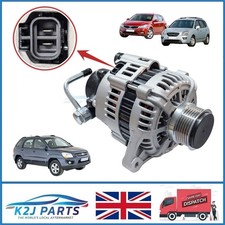 D4EA Alternator for Kia 2.0 CRDi Sportage Mk2 Carens Ceed Replaces 3730027010
GBP 138.49
D4EA Alternator for Kia 2.0 CRDi Sportage Mk2 Carens Ceed Replaces 3730027010
GBP 138.49
 HYUNDAI TUCSON Alternator 2020-2026 1.6L G4FT RDE2 373902M900
GBP 167.99
HYUNDAI TUCSON Alternator 2020-2026 1.6L G4FT RDE2 373902M900
GBP 167.99
 Alternator Febi Fits Carens Tucson Santa Fe Trajet 0.8 CRDi 2.0 2.2 3730027031
GBP 209.77
Alternator Febi Fits Carens Tucson Santa Fe Trajet 0.8 CRDi 2.0 2.2 3730027031
GBP 209.77
As an eBay Partner, Car United may earn commission from qualifying purchases shown above. Listings and pricing are pulled live from eBay and may vary.
Warning Signs, DIY Difficulty & Aftermarket Advice
These are the same regardless of make or model — see our full Alternator Guide for symptoms to watch for (plus a genuinely useful two-minute test to confirm it's not the battery instead), confirming the right amperage and fitment against your VIN, and which brands are worth trusting.
More Hyundai Alternator
The same part, covered across other Hyundai models.