
Nissan Note Radiator: Specs, Fitment & Common Faults
On the Note, an emptying coolant reservoir with no visible drip genuinely doesn't mean there's no leak — coolant can atomise against a hot component instead.
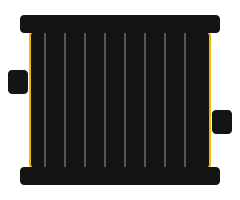 Illustration for editorial purposes
OEM Part Numbers
| Manual gearbox, all engines | Standard radiator with no transmission cooling circuit |
|---|---|
| Xtronic CVT, European/UK-spec cars | Genuinely uses a separate external "beehive"-style CVT oil cooler, air-cooled and mounted away from the main radiator — a different arrangement from the coolant-shared warmer fitted to North American-spec cars of the same model |
| Fitment note | CVT fluid temperature is known to run hot under sustained motorway driving or towing on this platform — confirm your exact market spec before assuming your car has (or lacks) the dedicated external cooler |
A Genuinely Useful Diagnostic Point Worth Knowing: No Drip Doesn't Mean No Leak — Nissan Note Radiator
If your coolant reservoir keeps emptying but you can't find a single drip anywhere underneath the car, this is genuinely worth knowing: coolant escaping and atomising against a hot component, such as a manifold or exhaust, rather than dripping straight down to the ground, is a real and well-documented possibility. The absence of a puddle in the garage doesn't mean the absence of a genuine leak.
It's also worth knowing that a genuinely useful, quick diagnostic technique is pressurising the coolant system directly, since some leaks — particularly around joints or hose connections that expand slightly when hot — only become visible under this kind of pressure test.
The Part That Keeps Everything Else From Cooking
Nothing about this component is glamorous, but almost every serious engine failure that isn't wear-related traces back to a cooling system problem left unaddressed. Catching the early signs here is genuinely cheap insurance against a much bigger bill.
What It Does
The radiator transfers heat from the engine coolant to the surrounding air, keeping engine temperature within a safe operating range. On automatic versions, it often also cools transmission fluid through a separate internal circuit — one more reason the correct part number matters so much here.
Shop for This Part on eBay
 FOR NISSAN NOTE (E11) 1.6 2006-2012 MANUAL / AUTOMATIC ENGINE COOLING RADIATOR
GBP 43.95
FOR NISSAN NOTE (E11) 1.6 2006-2012 MANUAL / AUTOMATIC ENGINE COOLING RADIATOR
GBP 43.95
 2016 NISSAN NOTE RADIATOR 1.2 PETROL 214103VA1A
GBP 94.95
2016 NISSAN NOTE RADIATOR 1.2 PETROL 214103VA1A
GBP 94.95
 Radiator For Nissan Note MK1 E11 1.4 / 1.6 2006-2012 Manual Transmission
GBP 50.50
Radiator For Nissan Note MK1 E11 1.4 / 1.6 2006-2012 Manual Transmission
GBP 50.50
 2015 NISSAN NOTE RADIATOR PACK 1.2 PETROL 214103VA1A
GBP 94.95
2015 NISSAN NOTE RADIATOR PACK 1.2 PETROL 214103VA1A
GBP 94.95
 Fits Nissan Note 2006-2013 Radiator 1.6 I Petrol Automatic With/Without Ac
GBP 41.69
Fits Nissan Note 2006-2013 Radiator 1.6 I Petrol Automatic With/Without Ac
GBP 41.69
 NISSAN NOTE Radiator 2004-2013 1.5L K9K608
GBP 56.49
NISSAN NOTE Radiator 2004-2013 1.5L K9K608
GBP 56.49
 NISSAN NOTE RADIATOR E11MK1 2009-2013 PETROL MANUAL WATER RADIATOR 21410BH40A
GBP 41.25
NISSAN NOTE RADIATOR E11MK1 2009-2013 PETROL MANUAL WATER RADIATOR 21410BH40A
GBP 41.25
 NISSAN NOTE E11E MK1 2011 RADIATOR 1.6L PETROL
GBP 90.40
NISSAN NOTE E11E MK1 2011 RADIATOR 1.6L PETROL
GBP 90.40
As an eBay Partner, CarUnited may earn commission from qualifying purchases shown above. Listings and pricing are pulled live from eBay and may vary.
Faults, DIY Difficulty & Aftermarket Advice
These are the same regardless of make or model — see our full Radiator Guide for the three common failure modes, confirming fitment against your VIN, and OEM vs aftermarket guidance.
More Nissan Radiator
The same part, covered across other Nissan models.