
Renault Clio Brake Discs: Specs, Fitment & Wear Symptoms
A genuine, specific disc fault called "lipping" with a real cost figure — plus a distinctive corroded fuse link that causes a total no-start "BRAKE FAULT" message.
 Illustration for editorial purposes
OEM Part Numbers
| Front discs, standard trims (260mm) | Vented, 22mm thickness, 19.8mm minimum — Renault OEM: 40 20 6 491 1R (also referenced as 77 01 2 077 95, 86 71 0 168 13) |
|---|---|
| Rear discs, standard trims | 240mm diameter, solid, 8mm thickness, 7mm minimum |
| Renaultsport 182/RS models | Front: 280mm diameter, vented, 24mm thickness, 21.8mm minimum. Rear: 238mm diameter, solid, 8mm thickness, 7mm minimum |
A Genuine, Specific Fault Worth Knowing: Disc "Lipping" — Renault Clio Brake Discs
If a service or MOT flags "lipping" on your discs, this is worth understanding rather than assuming it's the same as warping or corrosion: lipping refers to a raised ridge forming around the outer edge of the disc where the pad's contact area doesn't quite reach, gradually building up over normal wear. One documented case saw this flagged at just 20,000 miles and 3 years old, with a genuine dealer quote of £320 for discs and pads together — this is a legitimate, real cost benchmark worth having when comparing quotes elsewhere, even though it can feel surprising to need replacement this early on a car with genuinely low mileage.
It's also worth knowing that parking a freshly washed car away, especially in an enclosed garage while still wet, is a well-documented cause of the rear brakes binding — moisture between the pad and disc surfaces, combined with the handbrake holding them together while everything dries, can cause exactly this. If you're washing the car and putting it away, leaving the handbrake off (using a brick or leaving it in gear instead to hold the car) until everything's had a chance to dry properly is worth doing to avoid this.
The Part That Pads Depend On
Discs and pads work as a pair, and neglecting one tends to accelerate wear on the other — which is exactly why worn discs so often get discovered during what was meant to be a routine pad change.
What They Do
Brake discs provide the surface the brake pads clamp against to slow the car, converting momentum into heat through friction. Larger, sportier trims of the Clio typically use bigger discs than standard versions to handle the additional heat generated by more aggressive braking.
Shop for This Part on eBay
 Brake Discs & Brake Pads 240mm Rear for Renault Clio III Megane II 432005338R
GBP 67.99
Brake Discs & Brake Pads 240mm Rear for Renault Clio III Megane II 432005338R
GBP 67.99
 2x Vented Brake Discs and Pads fits RENAULT CLIO Mk3 1.2 Front 05 to 14 260mm
GBP 44.80
2x Vented Brake Discs and Pads fits RENAULT CLIO Mk3 1.2 Front 05 to 14 260mm
GBP 44.80
 2x Vented Brake Discs and Pads fits RENAULT CLIO Mk4 1.5D Front 12 to 21 258mm
GBP 50.94
2x Vented Brake Discs and Pads fits RENAULT CLIO Mk4 1.5D Front 12 to 21 258mm
GBP 50.94
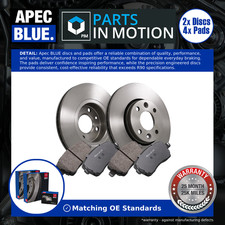 2x Vented Brake Discs and Pads fits RENAULT CLIO Mk4 Front 12 to 21 258mm Set
GBP 50.93
2x Vented Brake Discs and Pads fits RENAULT CLIO Mk4 Front 12 to 21 258mm Set
GBP 50.93
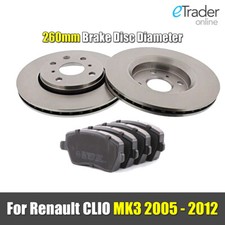 RENAULT CLIO MK3 FRONT BRAKE DISCS & And PADS 1.2 1.4 1.5 DCI 1.6 VVT SET 05-12
GBP 59.98
RENAULT CLIO MK3 FRONT BRAKE DISCS & And PADS 1.2 1.4 1.5 DCI 1.6 VVT SET 05-12
GBP 59.98
 Brake Discs and Pads Vented fits RENAULT CLIO KR, Mk3 Front 1.2 1.4 1.6 1.5D Set
GBP 53.30
Brake Discs and Pads Vented fits RENAULT CLIO KR, Mk3 Front 1.2 1.4 1.6 1.5D Set
GBP 53.30
 2x Vented Brake Discs and Pads fits RENAULT CLIO Mk2 1.2 Front 98 to 16 259mm
GBP 43.12
2x Vented Brake Discs and Pads fits RENAULT CLIO Mk2 1.2 Front 98 to 16 259mm
GBP 43.12
 2x Vented Brake Discs and Pads fits RENAULT CLIO Mk3 1.5D Front 05 to 14 260mm
GBP 44.78
2x Vented Brake Discs and Pads fits RENAULT CLIO Mk3 1.5D Front 05 to 14 260mm
GBP 44.78
As an eBay Partner, Car United may earn commission from qualifying purchases shown above. Listings and pricing are pulled live from eBay and may vary.
Wear Symptoms, DIY Difficulty & Aftermarket Advice
These are the same regardless of make or model — see our full Brake Discs Guide for warning signs to watch for, confirming fitment against your VIN, and choosing a reliable aftermarket disc.
More Renault Brake Discs
The same part, covered across other Renault models.