
Audi A3 Exhaust System: Specs, Fitment & Common Faults
A genuinely money-saving finding: power loss and heavy smoke that looks like DPF failure can actually be a faulty exhaust back pressure sensor giving incorrect readings — plus an important legal clarification that DPF deletes aren't actually legal in the UK.
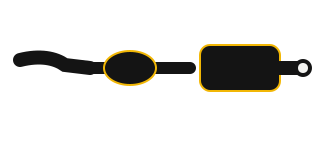 Illustration for editorial purposes
Opens live listings in a new tab.
OEM Part Number: confirm via VIN — Rear silencer (aftermarket) Bosal 105-137 / Walker 13379
| Rear silencer (back box) — aftermarket | Bosal 105-137, 105-031, 105-017, 105-127 (all need accessories); Walker 13379 (1050 mm, 5.22 kg, code letter 53, filled, no fitting parts); Vegaz VS-37 (1040 mm), AS-86 (1070 mm), AS-162 (990 mm), AS-313AT (1060 mm); Polmo 01.124 (with cat) / 01.14 (without cat) / 01.05 (manual, round tailpipe); Izawit 15.003; Imasaf 13.51.07 (940 mm) |
|---|---|
| Centre / intermediate silencer — aftermarket | Bosal 105-111, 105-109; Walker 21576 (800 mm, code 52), 21575 (790 mm, code 52, with pipe), 21903 (850 mm, code 52, round); Ernst 202022 (830 mm), 202046 (830 mm), 153003 (810 mm resonator); MTS 01.59790 (880 mm), 01.59800 (900 mm resonator); Asmet 21.009; Vegaz VS-293AT, VS-293IMA (880 mm); Polmo 01.106/01.104 (with cat) |
| Front pipe / catalytic converter (DPF on diesels) — aftermarket | or DPF: Bosal 090-285 (Euro 5, ECE, with fitting parts); Bosal 099-572 / 099-827 (Euro 1-2 only); Walker 20787 (1200 mm, code 93, with pipe and fitting parts); BM Catalysts BM31200H (Euro 6, only with FK31200), BM91518H (Euro 4, FK91518); JMJ 1091674 (540 mm manifold cat), 1091519 (910 mm; BLP/BLF/FSI/BCA, BAG/BLN/BKG), 1091391 (1050 mm; BSF/BSE/BGU), 1091520 (AUM/AUQ/ARY etc.) |
| Genuine (OE) numbers quoted | None quoted in catalogue listings — order genuine parts against your VIN |
| Fitment notes | several JMJ engine codes (ASZ/ASV/ALH/AHF, BAG/BCA) are older VW-group engines, so check fitment. |
Audi A3 Exhaust System: The Part That Announces Its Own Problems
On the Audi A3, you'll typically hear this fault developing long before you'd ever see it — a new rattle, an odd drone, noise levels creeping up from one week to the next. That early audible warning is a genuine head start on catching the problem before it worsens.
Audi A3 Exhaust System: What It Does
The Audi A3's exhaust does more than just carry gases away from the engine — it also handles noise reduction through the silencer and emissions treatment via a catalytic converter and particulate filter. That's why petrol and diesel versions can use entirely different systems.
Audi A3 Exhaust System: Watch: Replacing It
8V back box work; a delete rather than a replacement. Alt: https://www.youtube.com/watch?v=bIWtA0K2wV0 (Catback Audi A3 8V 1.5 TFSI).
Opens live listings in a new tab.
A Genuinely Money-Saving, Real Finding Worth Knowing Before Assuming DPF Failure — Audi A3 Exhaust System
If you're facing power loss and heavy smoke alongside a warning light, this is genuinely worth knowing before assuming the DPF itself has failed: one documented case saw these exact symptoms traced to a faulty exhaust back pressure sensor, which was giving incorrect readings and causing incomplete DPF regeneration cycles as a result. Replacing this specific sensor and cleaning the exhaust system resolved the fault entirely, without needing to replace the DPF itself — worth having this sensor checked first given how much cheaper it is than a full DPF replacement.
It's also genuinely worth knowing an important legal clarification: removing emissions control equipment that was fitted to achieve type approval is already a legal requirement not to do in the UK, and while a "DPF delete" might currently pass an MOT test due to the absence of roadside emissions testing and this not being specifically checked in the MOT tester's manual, this doesn't make the practice itself legal — worth knowing this is expected to change as emissions testing evolves, and a DPF delete carries genuine legal risk regardless of whether it currently passes an MOT.
Audi A3 Exhaust System: Warning Signs, DIY Difficulty & Aftermarket Advice
These are the same regardless of make or model — see our full Exhaust System Guide for warning signs and fault codes to watch for, confirming fitment against your VIN, and which aftermarket brands are worth trusting.
More Audi Exhaust System
The same part, covered across other Audi models.