
Audi A3 Radiator: Specs, Fitment & Common Faults
Confirmed: a safety recall addressed water pump issues on the 2015 model, with problems documented occurring between 30,000 and 70,000 miles — plus a clarification that genuine water pump-caused overheating is actually rare.
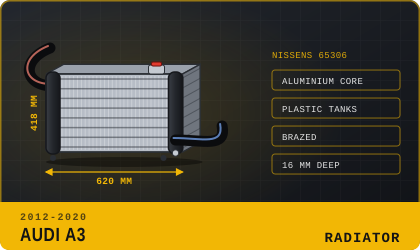 Illustration for editorial purposes
Opens live listings in a new tab.
OEM Part Number: confirm via VIN
Aftermarket units: Nissens 65306 / Mahle CIR 34 000P
| Radiators (aftermarket) | Ava Quality Cooling VNA2383 (620 x 418 x 16 mm, brazed aluminium core with plastic tanks, 1.0 TFSI and 1.2 TFSI); Nissens 65306; Mahle CIR 34 000P; JDEUS M-0300640; Kale 355615; Hart 623 812 |
|---|---|
| Core sizes & variants | The small-petrol 8V uses this 620 x 418 mm, 16 mm-deep core. The 1.4 TFSI, 1.8/2.0 TFSI and the 1.6/2.0 TDI diesels use a larger, deeper MQB core and are not covered by this part, so match the engine code before ordering. |
| Genuine (OE) numbers quoted | None quoted in catalogue listings — order a genuine unit against your VIN |
| Fitment notes | 22 mm inlet and outlet stubs; seals are not listed as included, so re-use or replace the hose O-rings separately. |
What happens when the A3's cooling fails
It's an unglamorous part, but on the Audi A3, the cooling system is behind almost every serious non-wear engine failure that could have been prevented. Spotting trouble here early is about as cheap an insurance policy as exists against an expensive repair bill.
How the A3's fan and core work together
On the Audi A3, heat from the engine coolant is shed to the surrounding air through the radiator, keeping engine temperature in a safe range. On automatic gearboxes, it often doubles up, cooling transmission fluid through a separate internal circuit too — which is why getting the exact part number right matters more here than on a simple heat exchanger.
Watch: replacing it8V A3; a 2020 A3 install (o2PPqCPD4ds) also exists.
Opens live listings in a new tab.
A water pump recall and the A3
This is worth checking directly, particularly on a 2015 model: a confirmed recall addressed water pump issues that could cause coolant to leak from the pump housing, worth checking your specific VIN against the official recall register directly. Note too that water pump problems on this platform have been documented occurring anywhere from as early as 30,000 miles up to around 70,000 miles, worth being particularly vigilant for early warning signs within this mileage window.
Genuine overheating caused directly by a failed water pump is actually quite rare. More often, overheating stems from warped cylinder heads or a weakened head gasket, frequently the lingering result of a previous overheating event, intermittently sealing and unsealing and discharging cylinder compression into the cooling system. If your car has overheated even once before, this may already be the underlying cause of an ongoing coolant issue, rather than the water pump itself being newly at fault.
Faults, DIY difficulty and aftermarket adviceThese are the same regardless of make or model — see our full Radiator Guide for the three common failure modes, confirming fitment against your VIN, and OEM vs aftermarket guidance.
The same part on other modelsThe same part, covered across other Audi models.