
Audi A3 Tail Lights: Specs, Fitment & Common Faults
Identical cars parked side by side showed completely different condensation patterns, some had it, some didn't — plus an account of a dealer replacing the whole cluster with no questions asked during a routine service.
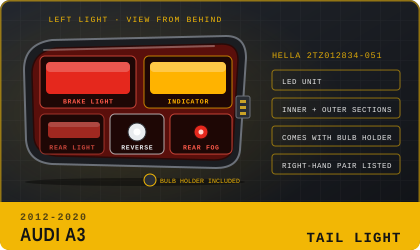 Illustration for editorial purposes
Opens live listings in a new tab.
OEM Part Number: confirm via VIN
Aftermarket rear lamps: Hella 2SD012831-031 / Magneti Marelli 714081040701
| Tail lights (aftermarket) | Hella 2TZ012834-051 (left, with bulb holder, inner section); Hella 2SD012831-031 (left, LED, outer section); Magneti Marelli 714081040701 (left, with bulb holder, outer section, right-hand pair 714081040801); Magneti Marelli 714081110701 (left, LED, with bulb holder, inner section, right-hand pair 714081110801) |
|---|---|
| Genuine (OE) numbers quoted | None quoted in the catalogue listings — the genuine light varies by trim, bulb or LED type and facelift date, so order it against your VIN |
| Fitment notes | Left and right are separate parts; check LED or bulb type, whether the bulb holder is included, body style and facelift date before ordering. |
Why a rear lamp swap on the A3 involves more than bulbs
The Audi A3's tail light unit combines several jobs in one housing — brake, indicator, reversing and rear fog light — so a single fault can knock out more than one function at once, and "the tail light's not working" isn't one specific problem.
How the A3 signals to traffic behind
Beyond basic rear visibility, tail light units on the A3 typically integrate brake lights, indicators, reversing lights and rear fog lights into a single housing. Higher trims may use LED units with a distinct light signature, which are not interchangeable with standard halogen units even if the physical mounting looks similar.
Generations, Derivatives and Lamp Type| 8V pre-facelift (2012–2016) | Halogen or LED depending on trim — both were offered within this same generation, so confirm your exact original spec before ordering |
|---|---|
| 8V facelift/8V.5 (2016–2020) | Genuine "Dynamic" LED tail lights with sweeping/sequential indicators became available, a distinct design from the pre-facelift units — not a direct swap onto pre-facelift cars without additional wiring |
| S3/RS3 | Shares the same tail light generational split as standard A3 — no unique S3/RS3-only tail light design confirmed, though badging and trim differ |
| Market/fitment note | Dynamic sweeping-indicator tail lights are plug-and-play on most markets, but require additional coding, adapters, or a wire split for the brake and indicator circuits on North American-spec cars |
This video is of an earlier generation of the same model; the job is similar but the light fittings and clips can differ slightly.
Tail light design changed between generations of the A3, and facelifted versions within the same generation often use a revised light signature that isn't interchangeable with pre-facelift units. Always confirm the exact part for your specific model year before ordering. Whether you're sourcing a replacement tail lights for your Audi A3 from a dealer, specialist, or online marketplace, always check compatibility against your registration or VIN before buying, and confirm you're ordering the correct side — driver's side (RH in the UK) or passenger side (LH in the UK) — since these are not interchangeable.
Opens live listings in a new tab.
Why some A3 rear lamps mist and others don't
If a dealer suggests condensation in a tail light is simply normal for this model, one case saw an owner walk around several other, otherwise identical cars parked outside a dealership for sale, and found that some showed exactly this condensation while others didn't — worth knowing this isn't necessarily a universal design characteristic affecting every single car of this model, and worth pushing for a proper repair rather than accepting a blanket "that's just how they are" explanation.
Bear in mind that two distinct causes worth checking separately: the rubber seal between the cluster and the bulb holder should have its internal groove running centred and straight all the way around, worth checking this hasn't become twisted or misaligned, and separately worth inspecting the cluster itself closely for any hairline cracks. In at least one case, the actual cause turned out to be neither of these, but the light unit itself physically starting to separate at a seam over time — worth knowing this is a different, distinct failure mode from a simple seal or crack issue.
Common faults, DIY difficulty and aftermarket adviceThese are the same regardless of make or model — see our full Tail Lights Guide for diagnosing which circuit has failed, how easy this job is to DIY, and aftermarket advice.
The same part on other modelsThe same part, covered across other Audi models.