
BMW X5 Spark Plugs: Intervals, Fitment & Warning Signs
A genuinely honest account: a persistent, cylinder-specific misfire survived swapping the coil and fitting both a new plug and new coil to test — worth being prepared for further investigation if the fault doesn't clear after this.
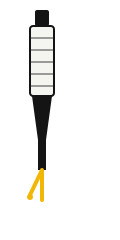 Illustration for editorial purposes
Opens live listings in a new tab.
BMW X5 Spark Plugs: OEM Part Number
BMW X5 Spark Plugs: A Cheap Part That Causes Expensive-Feeling Problems
On the BMW X5, spark plug wear tends to creep in quietly — idle gets a little rougher, throttle response softens slightly — the kind of symptoms that get blamed on almost anything else under the bonnet. Given how cheap the part itself is, it's an easy one to put off for longer than makes sense.
BMW X5 Spark Plugs: What They Do
Inside each cylinder of the BMW X5, spark plugs ignite the compressed fuel-air mixture, and their condition has a direct effect on combustion efficiency, fuel economy and how smoothly the engine runs. Petrol engines can't function without them; diesels don't use spark plugs, relying on compression alone to ignite fuel.
BMW X5 Spark Plugs: Generations, Engines & Spark Plug Count
| Diesel variants (25d, 30d, 40d, 40e diesel plug-in hybrid) | Not applicable — diesel engines use compression ignition and have no spark plugs at all |
|---|---|
| Petrol four-cylinder (25e plug-in hybrid, 40e petrol plug-in hybrid on some model years) | 4 spark plugs — one per cylinder |
| Petrol six-cylinder (30i, 40i, 45e plug-in hybrid) | 6 spark plugs — BMW's inline-six family, genuinely a different engine from the four-cylinder units |
| Petrol V8 (50i, M50i, X5 M) | 8 spark plugs — BMW's twin-turbo V8; early N63 examples (2008–2012) have a well-documented reputation for higher oil consumption and turbocharger issues worth knowing about alongside plug replacement |

Opens live listings in a new tab.
A Genuinely Honest, Real Account Worth Knowing — BMW X5 Spark Plugs
If a specific cylinder keeps misfiring despite trying to fix it, this is genuinely worth knowing: one documented case saw a persistent misfire on a specific cylinder survive swapping the coil to a different cylinder, then fitting both a brand new spark plug and a new coil specifically to test — with the misfire still occurring immediately on every single startup afterward. It's genuinely worth knowing that even replacing both the plug and coil together isn't always guaranteed to resolve a stubborn, cylinder-specific misfire, worth being prepared for further investigation into wiring, the injector, or a compression issue on that specific cylinder if the fault persists.
It's also genuinely worth knowing that coil packs have been documented failing even on cars with genuinely low mileage, worth knowing that mileage alone isn't a reliable indicator of whether this specific component needs replacing.
BMW X5 Spark Plugs: Warning Signs, DIY Difficulty & Aftermarket Advice
These are the same regardless of make or model — see our full Spark Plugs Guide for symptoms of worn plugs, why matching your exact plug specification matters, and trusted brands to buy from.
More BMW Spark Plugs
The same part, covered across other BMW models.