
Dacia Duster Alternator: Specs, Fitment & Common Faults
A valuable, real saga: multiple alternators replaced over weeks before the actual fault turned out to be simply dirty wires — plus a UK consumer rights point.
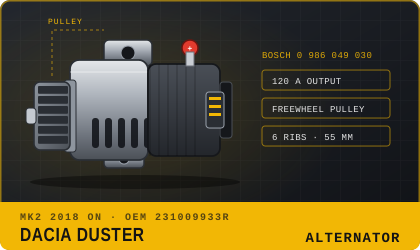 Illustration for editorial purposes
Opens live listings in a new tab.
OEM Part Number: 231009933R
Genuine alternator, confirm via VIN. Aftermarket alternators: Bosch 0 986 049 030 / Valeo 439646
| Alternators (aftermarket) | Bosch 0 986 049 030 (120 A, freewheel pulley, 6 ribs, 55 mm, reman exchange, plug 124, excludes vacuum pump, £50.24 surcharge); Bosch 0 986 080 410 (150 A, freewheel pulley, 6 ribs, 55 mm, reman exchange, plug PL124, excludes vacuum pump, £94.06 surcharge); Valeo 439646 (150 A, freewheel pulley, 6 ribs, 56 mm, new, B+ clamp); Valeo 440056 (125 A, freewheel pulley, 6 ribs, 55 mm, reman exchange with deposit, four-point fixing, £50.24 surcharge); Valeo 440679 (120 A, freewheel pulley, 7 ribs, reman exchange with deposit, four-point fixing, £50.24 surcharge); Lucas LRA03871 (90 A, freewheel pulley, 7 ribs, 49 mm, reman, plug 0293, COM/LIN2C, £50.24 surcharge); AS-PL A3563S (120 A, freewheel pulley, 7 ribs, 48.6 mm, new, plug PL_2801); AS-PL A3552S (150 A, freewheel pulley, 6 ribs, 55 mm, new, plug PL_2800) |
|---|---|
| Outputs & variants | Two pulley families are listed. The 7-rib, 48.6 to 50 mm units at 90 A and 120 A fit the 1.0 and 1.3 TCe petrol engines with the narrower belt, while the 6-rib, 55 to 57 mm units at 120 A, 125 A and 150 A fit the 1.5 dCi diesel and 1.6 SCe petrol; 150 A is the higher-output diesel and LPG fitment. |
| Genuine (OE) numbers quoted | TG12C164 (AS-PL A3563S, 120 A); 0124425037 (AS-PL A0763S, 120 A); FG15T056 (AS-PL A3552S, 150 A); SG12B105 (AS-PL A3118, 125 A); FG15T057 (AS-PL A3561S, 150 A). |
| Fitment notes | Count the ribs on the old pulley first, since the 7-rib petrol unit and 6-rib diesel unit are not interchangeable even at the same amperage. All units are freewheel pulley types. Bosch and Ridex references exclude the vacuum pump. Reman Bosch, Valeo and Lucas units carry £50.24 surcharges, with the 150 A Bosch at £94.06; AS-PL PR units are exchange without a deposit. |
A long run of replacements for a fault on the Duster
If you're facing an intermittent alternator fault, this real saga is useful to know about before authorising expensive parts replacement: one owner went through multiple alternators — an incorrect one fitted first, then a correct replacement ordered from France with a multi-week wait, twice — with the fault persisting throughout, and dealers unable to replicate or diagnose it despite the car's own computer confirming an intermittent fault was present. The eventual, simple root cause: dirt on the wiring connections to the alternator. Once cleaned, the fault was resolved completely, with no further parts needed at all. If you're chasing an intermittent alternator warning that keeps returning despite replacement parts, it's worth insisting the wiring and connections are properly cleaned and inspected before authorising another alternator swap.
Note too that some drive belt and alternator noise on a new car can simply be normal — components can "sing" slightly when new before settling in, and this alone isn't necessarily a sign of a fault. If you're unsure whether a noise is normal or not, it's worth having a dealer confirm while the car is still under warranty rather than assuming the worst yourself.
Watch: replacing it2.0 petrol is a Mk1 export engine; Mk2 searches return belt, brush and multimeter videos only.

Telling a flat battery from a failing generator
Early on, a weak Dacia Duster battery and a dying alternator look almost identical — dim lights, sluggish starts, a car that won't hold its charge — which is exactly why so many people fit a new battery and end up back at the garage weeks later, the actual fault still unaddressed.
What happens to the Duster's charge once the engine runs
On the Dacia Duster, while the engine runs, the alternator generates the electricity that charges the battery and powers the car's electrical systems directly. With a healthy alternator, the battery's real job becomes starting the engine and covering brief demand spikes, rather than running the electronics on its own.
Opens live listings in a new tab.
These are the same regardless of make or model — see our full Alternator Guide for symptoms to watch for (plus a useful two-minute test to confirm it's not the battery instead), confirming the right amperage and fitment against your VIN, and which brands are worth trusting.
The same part on other modelsThe same part, covered across other Dacia models.