
Fiat Tipo Spark Plugs: Intervals, Fitment & Warning Signs
On the Tipo, if TwinAir, even after replacing a faulty coil the ECU can genuinely stay stuck in a reduced-power mode until fault memory is properly cleared.
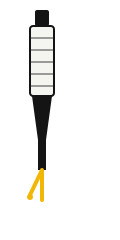 Illustration for editorial purposes
Opens live listings in a new tab.
OEM Part Number: confirm via engine code — aftermarket NGK 6046 / Bosch 0 242 135 515
| Petrol engines in this generation | 1.0 101 HP (357HXN1A), 1.4 95 HP (356HXA1B), 1.4 120 HP (356HXF1B), 1.6 110 HP (356HXE11); 1.4 LPG and 1.5 T4 Hybrid also listed |
|---|---|
| Spark plugs (aftermarket) | NGK 6046 (iridium, M12x1.25, 16 mm, thread 19 mm); NGK 93311 (iridium); NGK 95536 (iridium, gap 1.0 mm, thread 20.5 mm); NGK 4983 and 94037 (nickel); Bosch 0 242 135 515 (gap 1.0 mm); Bosch 0 242 140 519 (gap 0.7 mm); Bosch 0 242 140 514 (gap 0.7 mm); Denso IXU22FTT (iridium, platinum earth) |
| Genuine (OE) numbers quoted | Kamoka 7090522 = 46 82 32 99; Kamoka 7090544 = 55190788; Denso XU22TT = 1WT418110; Denso XU22EPR-U = 55188857 |
| Fitment notes | Every plug is the 16 mm hex M12x1.25 family with 19 mm reach, mostly iridium or nickel. |
A Genuinely Important Technical Fact Worth Knowing on TwinAir Models — Fiat Tipo Spark Plugs
If you've replaced a faulty ignition coil on the TwinAir engine but the car still feels down on power, this is genuinely worth knowing: when a coil fails, the ECU logs misfire faults and can drop into a catalyst-protection limp mode. Even after the coil has been correctly replaced, the ECU can remain in this reduced-power state until the fault memory has been properly cleared using the correct diagnostic equipment — cheap, generic OBD readers often can't display or clear these specific fault codes.
It's also genuinely worth knowing a useful UK consumer rights point: a persistent, unresolved misfire that a dealer fails to properly diagnose after multiple attempts, particularly on a recently purchased car, can potentially be sufficient grounds for rejecting the car entirely under UK consumer protection law.
Fiat Tipo Spark Plugs: A Cheap Part That Causes Expensive-Feeling Problems
On the Fiat Tipo, there's rarely a clear signal when spark plugs wear out — just a rougher idle, marginally less pep off the line — vague enough to get pinned on other engine issues. Since the part costs so little, it's also one of the easiest things to keep putting off.
Fiat Tipo Spark Plugs: Watch: Replacing It
Tipo 1.6 E-torQ, English narration assumed
Fiat Tipo Spark Plugs: What They Do
On the Fiat Tipo, combustion efficiency, fuel economy and smooth running all trace back to spark plug condition, since these are what ignite the compressed fuel-air mixture in each cylinder. Petrol engines depend on them entirely — diesels skip spark plugs altogether, igniting fuel through compression instead.
Fiat Tipo Spark Plugs: Generations & Spark Plug Count
| Diesel variants | Not applicable — diesel engines use compression ignition and have no spark plugs at all |
|---|---|
| Petrol variants (all trims) | 4 spark plugs — one per cylinder |
Opens live listings in a new tab.
Fiat Tipo Spark Plugs: Warning Signs, DIY Difficulty & Aftermarket Advice
These are the same regardless of make or model — see our full Spark Plugs Guide for symptoms of worn plugs, why matching your exact plug specification matters, and trusted brands to buy from.
More Fiat Spark Plugs
The same part, covered across other Fiat models.