
Ford Ka+ Spark Plugs: Intervals, Fitment & Warning Signs
A warning about engine temperature before removing the Ka+'s plugs, plus why real-world owners often change these ahead of schedule.
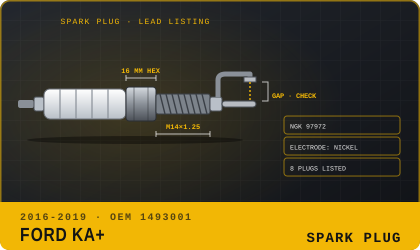 Illustration for editorial purposes
Opens live listings in a new tab.
OEM Part Number: 1493001
As quoted in catalogue listings, confirm via engine code. Aftermarket plugs: NGK 97972 / Bosch 0 242 229 785
| Petrol engines in this generation | 1.2 (70 HP), 1.0 Flexfuel (86 HP); diesel 1.5 TDCi also listed |
|---|---|
| Spark plugs (aftermarket) | NGK 97972 (nickel, 1.3 mm gap, 16 mm hex, M14x1.25); NGK 96463 (nickel, M14x1.25); Bosch 0 242 229 785 (1.3 mm gap, M14x1.25); Bosch 0 242 236 633 (1.2 mm gap, M14x1.25); Bosch 0 242 236 675 (0.7 mm gap, M14x1.25); Champion OE031/T10 (copper, 1.0 mm gap, M14x1.25); Champion CCH9016 (iridium, 0.8 mm gap, M14x1.25); Denso TV16TT (nickel, 16 mm hex, M14x1.25) |
| Genuine (OE) numbers quoted | Ford 2249260 (genuine part); Denso T16VR-U10 (OE 1493001); Denso XU22EPR-U (OE 55188857) |
| Fitment notes | The 1.2 petrol takes a nickel or copper 16 mm hex M14x1.25 plug (1.3 mm gap, such as NGK 97972 and Bosch 0 242 229 785), with iridium upgrades from Denso and Champion. Some M12x1.25 plugs (Denso XU22EPR-U, Bosch 0 242 132 501) are also listed. No change interval is shown. |
Thread damage and hot heads on the Ka+
Worth knowing before attempting this yourself on the Ford Ka+: spark plugs should never be removed when the engine is either hot or fully cold-soaked (sat unused overnight) — the engine needs to be warm to the touch after cooling down for a period first. Removing plugs at the wrong temperature risks damaging the thread or the cylinder head itself, a considerably more expensive problem than the plug replacement you started with. On EcoBoost engines specifically, the aluminium cylinder head makes this more of a risk than on some older, simpler engines — over-tightening or working at the wrong temperature can strip threads that are more delicate than cast iron.
Note too that that Ford's official spark plug interval for the Ka+ (often around 100,000 miles on EcoBoost engines) is considerably longer than what many real-world owners actually do in practice — a meaningful number report changing plugs at 40,000-60,000 miles instead, citing noticeably improved throttle response and fuel economy, particularly on turbocharged engines that work the plugs harder than a naturally-aspirated equivalent. This isn't a hard rule, but if you're noticing a rough idle or slightly longer crank time on an EcoBoost with plugs approaching official end-of-life, fresh plugs are a cheap thing to try before assuming a more expensive fault.
Symptoms that send Ka+ owners to the wrong fix
On the Ford Ka+, symptoms of worn spark plugs are subtle by nature — a touch rougher at idle, a little less responsive off the line — and easy to attribute to almost any other engine gremlin. Because the part itself is so cheap, it's routinely overlooked well past when it should've been changed.
Ka Plus misfire diagnosis (spark plug wells); part 2 is tCPkQp4wfpA. Not a straight plug change.
Why plug gap and heat range matter
How well the Ford Ka+'s engine runs, how efficiently it burns fuel, and how smooth it feels are all tied to spark plug condition, since these ignite the compressed fuel-air mixture in each cylinder. That's a petrol-engine job — diesels ignite fuel through compression and have no spark plugs at all.
Generations and Plug Count| Petrol variants (1.2 Duratec, most trims) | 4 spark plugs — one per cylinder |
|---|---|
| 1.0 EcoBoost, where fitted | only 3 spark plugs — confirm your exact engine before ordering, since the Ka+ was offered with both a conventional four-cylinder and Ford's three-cylinder EcoBoost depending on trim and market |
Opens live listings in a new tab.
These are the same regardless of make or model — see our full Spark Plugs Guide for symptoms of worn plugs, why matching your exact plug specification matters, and trusted brands to buy from.
The same part on other modelsThe same part, covered across other Ford models.