
Hyundai i20 Cabin Air Filter: Intervals, Fitment & Warning Signs
On the i20, if a musty smell persists after a fresh filter, mould further downstream in the evaporator may be the real cause.
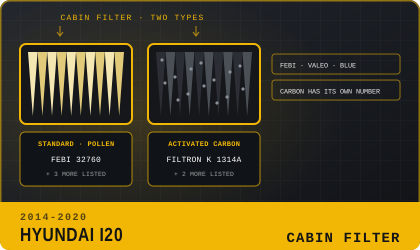 Illustration for editorial purposes
Opens live listings in a new tab.
OEM Part Number: confirm via VIN
Aftermarket pollen filters: Febi 32760 / Valeo 715816
| Cabin filter, standard (aftermarket) | Febi 32760, Valeo 715816, Blue Print ADG02557, Filtron K1314 |
|---|---|
| Activated-carbon version (aftermarket) | Filtron K 1314A, Febi 1002030, Blue Print ADBP250143 |
| Genuine (OE) number | Not quoted in the catalogue listings — the fitted filter varies by trim and build date, so order the genuine one against your VIN |
| Fitment notes | Standard and carbon filters have different numbers, and the right size depends on trim and build date. Check which type your car was built with before ordering. |
What to check after a fresh filter fails to help the i20
If a musty smell persists even after fitting a fresh cabin filter, mould or mildew can develop further downstream, on the evaporator core or within the ducting itself, meaning a new filter alone won't necessarily resolve it. With the filter removed, spraying a mould and mildew treatment down through the empty filter slot while running the blower on medium reaches the evaporator directly.
Note too that a sudden, noticeable reduction in airflow can occasionally be caused by debris or a rodent nest blocking the air intake at the base of the windscreen.
Overlooked but simple: the i20's pollen filter
Skipping this one on a Hyundai i20 won't cost you performance or reliability, only air quality inside the cabin — which is why it's routinely the most overdue item on any used car's maintenance history.
Watch: replacing itThis video is of an earlier generation of the same model; the filter job is similar but the cover and clips can differ slightly.

How the i20 protects passengers from road dirt
Two filters get mixed up constantly on the Hyundai i20: this one cleans air for the cabin ventilation system, catching dust, pollen and (on activated-carbon versions) some airborne pollutants, while the separate engine air filter deals purely with combustion air. They don't share a part number or a purpose.
Opens live listings in a new tab.
These are the same regardless of make or model — see our full Cabin Air Filter Guide for signs it needs changing, confirming fitment against your VIN, and choosing standard, carbon, or HEPA media.
The same part on other modelsThe same part, covered across other Hyundai models.