
Hyundai i20 Spark Plugs: Intervals, Fitment & Warning Signs
On the i20, a documented case on a related model saw ceramic plug cracking and coil failures recur four separate times on the same car.
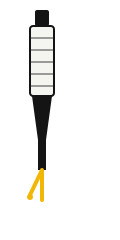 Illustration for editorial purposes
Opens live listings in a new tab.
Hyundai i20 Spark Plugs: OEM Part Number
A Genuinely Distinctive, Real Case Worth Knowing About — Hyundai i20 Spark Plugs
This is genuinely worth knowing if you're facing a recurring plug or coil fault that seems to keep coming back: one documented case on a related model saw ceramic spark plugs cracking and causing misfires, alongside ignition coil failures, recur four separate times on the same car, with each instance replaced under warranty only for the fault to return.
It's also worth knowing a genuinely useful distinction: unlike spark plugs, which are a genuine, expected consumable, ignition coils are not considered a standard wear-and-tear part — worth pushing back if a dealer tries to dismiss a coil failure as simply expected wear.
Hyundai i20 Spark Plugs: A Cheap Part That Causes Expensive-Feeling Problems
On the Hyundai i20, symptoms of worn spark plugs are subtle by nature — a touch rougher at idle, a little less responsive off the line — and easy to attribute to almost any other engine gremlin. Because the part itself is so cheap, it's routinely overlooked well past when it should've been changed.
Hyundai i20 Spark Plugs: What They Do
How well the Hyundai i20's engine runs, how efficiently it burns fuel, and how smooth it feels are all tied to spark plug condition, since these ignite the compressed fuel-air mixture in each cylinder. That's a petrol-engine job specifically — diesels ignite fuel through compression and have no spark plugs at all.
Hyundai i20 Spark Plugs: Generations, Engines & Spark Plug Count
| Diesel variants | Not applicable — diesel engines use compression ignition and have no spark plugs at all |
|---|---|
| 1.0 T-GDi (standard petrol trims, current generation) | Genuinely only 3 spark plugs — confirm your exact engine before assuming 4 |
| 1.2/1.4/1.6 (older generations, N performance trims) | 4 spark plugs — a conventional four-cylinder engine |
Opens live listings in a new tab.
Hyundai i20 Spark Plugs: Warning Signs, DIY Difficulty & Aftermarket Advice
These are the same regardless of make or model — see our full Spark Plugs Guide for symptoms of worn plugs, why matching your exact plug specification matters, and trusted brands to buy from.
More Hyundai Spark Plugs
The same part, covered across other Hyundai models.