
Kia Ceed Exhaust System: Specs, Fitment & Common Faults
On the Ceed, if diesel and told a blocked DPF is "your driving style," it's genuinely worth knowing the DPF is ECU-managed, not owner-serviceable.
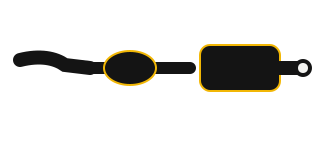 Illustration for editorial purposes
Opens live listings in a new tab.
OEM Part Number: confirm via VIN — Rear silencer (aftermarket) Bosal 169-217 / Walker 22970
| Rear silencer (back box) — aftermarket | Bosal 169-217, 169-041, 165-055 (need accessories); Walker 22970 (730 mm, 4.5 kg, code letter 52, no fitting parts); MTS 01.61273 (880 mm), 01.60576 (730 mm), trim codes listed; Vegaz KS-130 (760 mm), KS-112 (780 mm), KS-148, KS-149, MZS-51 (550 mm), KS-190; Polmo 47.60, 47.06, 47.71, 10.41; Izawit 36.036, 36.011 |
|---|---|
| Centre / intermediate silencer — aftermarket | Vegaz only: KS-137IMA (1000 mm), KS-126 (900 mm), KS-156IMA; No Bosal/Walker/MTS. |
| Front pipe / catalytic converter (DPF on diesels) — aftermarket | Bosal 090-213 (Euro 5/6, E9-103R-00.27568, with fitting parts); Vegaz HUK-306QP / HUK-306 (front, Euro 5/6, 450 mm), HUK-952QP (Euro 6), HUK-954, KK-927 (rear, Euro 4); BM Catalysts BM91956H (Euro 5), BM92478H (Euro 6); JMJ 1091620 (400 mm), 1091736; also NAP CAK11619 (Euro 6, 380 mm), AS 61083/61080 (Euro 6); No Walker. |
| Genuine (OE) numbers quoted | None quoted in catalogue listings — order genuine parts against your VIN |
| Fitment notes | Engines listed at category level only: petrol 1.0 T-GDI to 1.6 GT, diesel 1.4-1.6 CRDi; parts not tied to engine. The rear list is the same generic Kia set as Niro/Picanto/Rio/Sportage. |
A Genuinely Honest, Real Argument Worth Knowing If Told It's "Your Driving Style" — Kia Ceed Exhaust System
This is genuinely worth knowing if a dealer blames a blocked DPF on your driving style: the DPF itself is not a component you're expected to service — it's a fixed part of the exhaust system, self-managed by the car's ECU. Genuine contamination is typically the result of a fault with an associated component, such as the differential pressure sensor or EGR valve, rather than simply how the car is driven.
It's also genuinely worth verifying directly what emissions equipment your specific car actually has, rather than trusting a blanket claim from a dealer — one documented case saw a dealer incorrectly tell a buyer a specific diesel variant had no DPF at all, when it genuinely did.
Kia Ceed Exhaust System: The Part That Announces Its Own Problems
Where a lot of Kia Ceed parts fail silently until you spot something visually wrong, this one tends to make noise first — a rattle, a drone, an audible change that wasn't there recently. That's a useful early-warning system if you're paying attention.
Kia Ceed Exhaust System: Watch: Replacing It
Newer-gen Ceed (2018+), not 2012-18; rear silencer removal
Kia Ceed Exhaust System: What It Does
Away from the engine, through the silencer, and often through a catalytic converter and particulate filter before reaching the tailpipe — that's the Kia Ceed's exhaust job in three steps. Petrol and diesel versions frequently need different systems entirely, since their emissions treatment isn't the same.
Opens live listings in a new tab.
Kia Ceed Exhaust System: Warning Signs, DIY Difficulty & Aftermarket Advice
These are the same regardless of make or model — see our full Exhaust System Guide for warning signs and fault codes to watch for, confirming fitment against your VIN, and which aftermarket brands are worth trusting.
More Kia Exhaust System
The same part, covered across other Kia models.