
Land Rover Discovery Alternator: Specs, Fitment & Common Faults
Removing the alternator belt helps confirm whether it's the noise source — plus a simple rusty pulley fix, and a finding about a cascade of warnings appearing before the battery light itself.
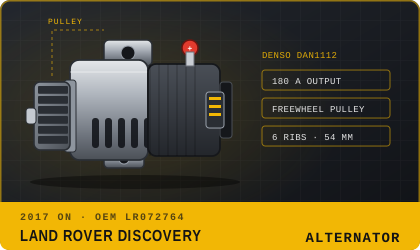 Illustration for editorial purposes
Opens live listings in a new tab.
OEM Part Number: LR072764
Genuine alternator, confirm via VIN. Aftermarket alternators: Denso DAN1112 / Hella 8EL 015 637-571
| Alternators (aftermarket) | Denso DAN1112 (180 A, freewheel pulley, 6 ribs, 54 mm, new); Hella 8EL 015 637-571 (180 A, V-ribbed pulley, 6 ribs, 54 mm, new); AS-PL A0837S (180 A, belt pulley, 6 ribs, 53 mm, new, PL_2305); AS-PL A0839S (230 A, belt pulley, 6 ribs, 53 mm, new, PL_2305); AS-PL A6248 (150 A, freewheel pulley, 6 ribs, 53.5 mm, new, PL_2305); AS-PL A6248PR (150 A, freewheel, 52 mm, remanufactured exchange, no deposit); Rotovis 9091601 (180 A, freewheel pulley, 6 ribs, 54 mm, remanufactured, COM plug); Ridex 4G0286 (150 A, freewheel pulley, 6 ribs, 54 mm, new, LIN plug, excludes vacuum pump) |
|---|---|
| Outputs & variants | 150 A Denso-pattern units for the 2.0 Ingenium engines, 180 A Denso-pattern freewheel units (54 mm) for the 3.0 TD6/SDV6 diesels and 230 A Bosch-pattern units (53 mm) for the heaviest-load specifications. The D250/D300/D350 MHEV engines use a 48 V starter-generator rather than a standard alternator. |
| Genuine (OE) numbers quoted | AS-PL A0837S quotes 0125812017; AS-PL A0839S quotes 0125813022; AS-PL A6248 quotes 104210-2420. |
| Fitment notes | The 3.0 V6 diesel, the common UK engine, takes the 180 A 54 mm freewheel unit (Denso DAN1112 or equivalent); Walker and Stardax exchange references carry a core charge (£21.94 to £50.24) and the mild-hybrid variants need specialist attention. |
The wrong part gets replaced first: charging faults on the Discovery
On the Land Rover Discovery, dim lights, slow starts, a battery that won't hold charge — these symptoms point equally to a weak battery or a failing alternator, and that overlap is why so many replacements target the wrong part first, with the real problem only surfacing weeks later.
How the Discovery keeps its battery topped up
Electricity generation while the Land Rover Discovery's engine is running is the alternator's job, charging the battery and directly powering the electrical systems. When it's working properly, the battery mostly just handles engine starting and short demand spikes, not day-to-day electrical load.
Watch: replacing itShares the D7u platform and engines with Discovery 5; no Discovery 5 alternator video exists.

Opens live listings in a new tab.
Pinning a squeal or whine to its source
If you're chasing a noise or electrical interference that might be coming from the alternator, removing the alternator drive belt and starting the engine briefly can help confirm whether the alternator itself is the source — if the noise or interference disappears with the belt removed, this confirms the alternator; if it persists, the cause likely lies elsewhere, such as the ignition system. A grinding or squeaking noise that worsens with engine speed has, in documented cases, been traced to a rusty alternator belt pulley, resolved entirely just by sanding the rust off the pulley surface.
Bear in mind that alternators from certain other Land Rover models have been documented as plug-and-play compatible replacements, worth researching whether a compatible unit from a related model exists before assuming only a specific, harder-to-source part will work.
Warning signs, DIY difficulty and aftermarket adviceThese are the same regardless of make or model — see our full Alternator Guide for symptoms to watch for (plus a useful two-minute test to confirm it's not the battery instead), confirming the right amperage and fitment against your VIN, and which brands are worth trusting.
The same part on other modelsThe same part, covered across other Land Rover models.