
Mazda 3 Brake Discs: Specs, Fitment & Wear Symptoms
On the Mazda 3, real technical bulletins on related models address poor rear disc wear, linked to Mazda's TCS braking balance.
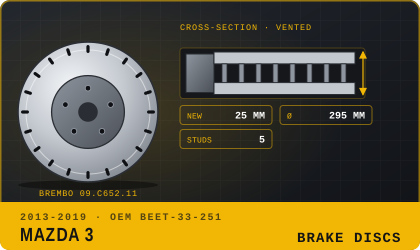 Illustration for editorial purposes
Opens live listings in a new tab.
OEM Part Number: BEET-33-251
Genuine front disc, confirm via VIN. Aftermarket front discs: Brembo 09.C652.11 / Bosch 0 986 479 D71
| Front brake discs (aftermarket) | TRW DF6731 (295 x 25 mm, vented, 5 holes, painted, minimum 23 mm, bolt circle 114.3); Brembo 09.C652.11 (295 x 25 mm, vented, 5 holes, coated, minimum 23 mm); Bosch 0 986 479 D71 (295 x 25 mm, vented, 5 holes, coated, high-carbon, ECE-R90, minimum 23 mm); ATE 24.0125-0208.1 (295 x 25 mm, vented, 5 holes, coated, minimum 23 mm); Zimmermann 370.3054.20 (295 x 25 mm, vented, 5 holes, coated, minimum 23 mm); Zimmermann 370.3054.52 (295 x 25 mm, vented, drilled, 5 holes, coated, minimum 23 mm); febi bilstein 108514 (295 x 25 mm, vented, 5 holes, coated, minimum 23 mm). |
|---|---|
| Disc sizes & variants | 295 mm x 25 mm vented is the front size for the BM from 1.5 petrol to 2.2 diesel. A 280 mm x 25 mm vented disc (ATE 24.0125-0214.1, Brembo 09.C651.11) is also catalogued for the model without axle position stated, and it covers the smallest-engined 1.5 cars. The 265 mm solid discs are rears. |
| Genuine (OE) numbers quoted | BEET-33-251 (genuine front disc number for this model — confirm via VIN, as several disc sizes exist) |
| Fitment notes | Measure the old disc before ordering because 280 mm and 295 mm fronts were both fitted to this generation; minimum thickness is 23 mm on the 295 mm disc. Five-stud, 114.3 mm bolt circle, 68 mm centre bore. |
Why the 3's rear rotors corrode early
If you're seeing premature rear disc corrosion or uneven wear, Mazda has issued confirmed technical service bulletins addressing poor rear brake disc wear on related models. Why this happens: forum discussion points toward the rear brakes being applied harder and sooner than the fronts as a result of how Mazda's traction control system balances braking, combined with smaller rear pads that some owners believe may be under-specced.
One owner, facing premature rear disc corrosion at just two years old, was told directly by Mazda UK that they were "washing their hands of it," declining warranty coverage and calling it fair wear and tear.
Watch: replacing themBM generation; a recorded livestream

Why worn rotors undo new pads on the 3
On the Mazda 3, discs and pads work as a pair, and neglecting one tends to accelerate wear on the other — which is exactly why worn discs so often get discovered during what was meant to be a routine pad change.
How braking force reaches the road
Brake discs provide the surface the brake pads clamp against to slow the car, converting momentum into heat through friction. Larger, sportier trims of the 3 typically use bigger discs than standard versions to handle the additional heat generated by more aggressive braking.
Opens live listings in a new tab.
These are the same regardless of make or model — see our full Brake Discs Guide for warning signs to watch for, confirming fitment against your VIN, and choosing a reliable aftermarket disc.
The same part on other modelsThe same part, covered across other Mazda models.