
Mercedes-Benz E-Class Brake Pads: Specs, Fitment & Wear Symptoms
On the E-Class, the brake wear warning resets itself automatically once pads and sensor are properly replaced — if it persists, this points to a genuine installation error.
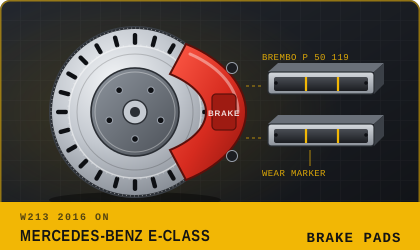 Illustration for editorial purposes
Opens live listings in a new tab.
OEM Part Number: confirm via VIN — front pads (aftermarket) Brembo P 50 119 / Bosch 0 986 494 750
| Front brake pads (aftermarket) | Brembo P 50 119 (144 x 60/70 x 19 mm, prepared for a wear indicator, TRW/Lucas/Girling); Brembo P 50 139 (142 x 96 x 18 mm, prepared, Brembo system); Brembo P 50 120 (128 x 93 x 19 mm, prepared, Brembo system); Bosch 0 986 494 750 (127.2 x 92.3 x 18.1 mm, low-metallic); Bosch 0 986 424 335 (142 x 96.3 x 18.8 mm, low-metallic); TRW GDB2070 (144 x 60.2/70 x 19.5 mm, prepared); ATE 13.0460-2792.2 (144 x 60/70 x 19.6 mm, prepared, contact excluded, TRW/Lucas/Girling); ATE 13.0460-4892.2 (141.9 x 96.2 x 18 mm, prepared, contact excluded, Brembo) |
|---|---|
| Pad sizes & variants | Two front families. The 144 x 60-70 x 19 mm set (and 175 x 69/78 mm Brembo P 50 124) fits the TRW/Lucas/Girling system; the 128-142 x 92-96 mm sets fit the Brembo system. Ferodo FDB4870 (144 x 60.1 mm) is listed only for specific brake variants. |
| Genuine (OE) numbers quoted | None quoted in catalogue listings — order genuine pads against your VIN |
| Fitment notes | The taller 92-96 mm pads are for cars with the larger Brembo-system front brakes. Brembo P 50 120 is not for carbon-ceramic discs. The ATE sets exclude the wear contact. |
Every version of the E-Class uses brake pads that wear down through normal use — the only real variable is how quickly, which depends on engine, trim, and (where fitted) whether the car has any form of regenerative braking to ease the load.
How the E-Class turns pedal pressure into stopping power
Brake pads clamp against the discs to convert the car's momentum into heat, slowing it down. On any version of the E-Class with hybrid assistance or regenerative braking, this system handles a meaningful share of everyday slowing, which can extend pad life compared with a purely petrol or diesel equivalent.
Watch: replacing them2019 car, so W213.

How pad size varies by E-Class version
| Front pads, standard | Confirm exact fitment via VIN — pad size on this model varies by engine and trim, not just by generation. |
|---|---|
| Front pads, standard brakes package (E220d confirmed) | a distinct part number from the row above on this same axle — trim or package differences like this typically mean a physically different pad, not just a relabelled one. |
| Front brake pads | a distinct part number from the row above on this same axle — trim or package differences like this typically mean a physically different pad, not just a relabelled one. |
| Front brake pad wear sensor | a distinct part number from the row above on this same axle — trim or package differences like this typically mean a physically different pad, not just a relabelled one. |
Opens live listings in a new tab.
How the E-Class decides its pad warning can go out
If a "check brake pad wear" warning won't clear despite fitting new pads, this warning resets itself automatically once the pads and wear sensor have been properly replaced, with no separate manual reset procedure needed via a scan tool. If the message persists after a replacement, this points toward a genuine installation error, such as the old sensor being mistakenly reinstalled, rather than needing specialist reset equipment.
Note too that a brake wear warning can sometimes appear after heavy rain, since moisture can occasionally interfere with the sensor circuit temporarily.
Wear symptoms, DIY difficulty and aftermarket adviceThese are the same regardless of make or model — see our full Brake Pads Guide for warning signs to watch for, confirming fitment against your VIN, and R90-certified aftermarket brands worth trusting.
The same part on other modelsThe same part, covered across other Mercedes-Benz models.