
Nissan Qashqai Radiator: Specs, Fitment & Common Faults
A genuinely severe, well-documented fault: a real forum tally found over 40% of thermostat housing failures resulted in a full replacement engine, with costs ranging from £700 to £10,000.
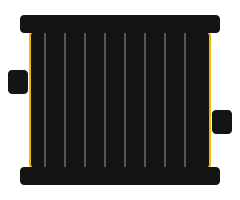 Illustration for editorial purposes
Opens live listings in a new tab.
Nissan Qashqai Radiator: OEM Part Number
| Manual gearbox, all engines | Standard radiator with no transmission cooling circuit |
|---|---|
| Xtronic CVT, European/UK-spec cars | Genuinely uses a separate external "beehive"-style CVT oil cooler, air-cooled and mounted away from the main radiator — a different arrangement from the coolant-shared warmer fitted to North American-spec cars of the same model |
| Fitment note | CVT fluid temperature is known to run hot under sustained motorway driving or towing on this platform — confirm your exact market spec before assuming your car has (or lacks) the dedicated external cooler |
A Genuinely Severe, Well-Documented Fault Worth Understanding — Nissan Qashqai Radiator
If your Qashqai has the 1.3 DIG-T engine, this is genuinely worth understanding given how consistently and severely it's documented: the plastic thermostat housing has a well-known tendency to crack or shear off, and one dedicated forum thread tracking documented cases recorded 14 affected owners over time — of those, 8 needed the thermostat housing replaced, but 6 (over 40% of documented cases) needed a full replacement engine after the leak went undetected long enough to cause serious damage. Real cost figures worth knowing: a straightforward housing repair has been quoted around £700 out of warranty, while a full engine replacement following undetected damage has been quoted as high as £10,000. Failures have been documented across a genuinely wide range of mileages, from as low as 28,000km up to 140,000km, so this isn't limited to only very high-mileage examples.
A genuinely useful early warning sign worth knowing: an emptying coolant reservoir with absolutely no visible drips anywhere underneath the car has been documented repeatedly — coolant escaping and atomising against a hot component rather than dripping to the ground is a real possibility, so the absence of a puddle doesn't mean the absence of a genuine leak.
Nissan Qashqai Radiator: The Part That Keeps Everything Else From Cooking
Unglamorous as it is, the Nissan Qashqai's cooling system sits behind nearly every serious engine failure that isn't just ordinary wear — and one that went unaddressed for too long. Noticing early warning signs here is a small cost against a potentially very large one.

Nissan Qashqai Radiator: What It Does
On the Nissan Qashqai, engine coolant sheds its heat into the passing air via the radiator, which is what keeps engine temperature in a safe working range. On automatics, it frequently pulls double duty cooling the transmission fluid through its own internal circuit — a detail that makes getting the exact part number right especially important.
Opens live listings in a new tab.
Nissan Qashqai Radiator: Faults, DIY Difficulty & Aftermarket Advice
These are the same regardless of make or model — see our full Radiator Guide for the three common failure modes, confirming fitment against your VIN, and OEM vs aftermarket guidance.
More Nissan Radiator
The same part, covered across other Nissan models.