
Nissan Qashqai Spark Plugs: Intervals, Fitment & Warning Signs
A genuinely important reason not to delay: unburnt fuel from a misfire can damage the catalytic converter — plus a real, money-saving test to identify the specific failed coil rather than replacing all four.
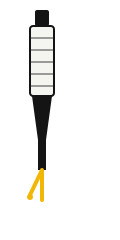 Illustration for editorial purposes
Opens live listings in a new tab.
OEM Part Number: confirm via engine code — aftermarket NGK 91121 / Bosch 0 242 140 565
| Petrol engines in this generation | 1.2 DIG-T 115 HP; 1.3 DIG-T 140/158/160 HP; 1.6 DIG-T 163 HP |
|---|---|
| Spark plugs (aftermarket) | NGK 91121 (iridium, M12x1.25, 14 mm hex); NGK 95003 (iridium, M12x1.25, 14 mm hex, 28.5 mm reach); NGK 90061 (iridium, M12x1.25, 14 mm hex); NGK 90912 (iridium, gap 0.7 mm, M12x1.25, 14 mm hex); NGK 90565 (iridium, M12x1.25, 14 mm hex, 28.5 mm reach); Bosch 0 242 140 565 (gap 0.7 mm, M12x1.25, 14 mm hex); Denso IXEH22FTT (iridium centre, platinum earth, M12x1.25) |
| Genuine (OE) numbers quoted | Kamoka 7100015 is quoted against 22401-00Q0K; Kamoka 7100016 against 22 40 191 33R; Renault 224019185R and 224011KC1C are listed as OE parts with no further number |
| Fitment notes | The 0.7 mm-gap iridium family (NGK 90061 / 90912, Bosch 0 242 140 565, Champion OE261, Beru Z379) is listed for the turbo petrols, with the longer 28.5 mm-reach NGK 95003 and 90565 as engine-specific variants; Champion OE240 and Hella 8EH 188 869-401 are 1.0 mm-gap types. No change interval is shown. |
A Genuinely Important Reason Not to Delay: Catalytic Converter Damage — Nissan Qashqai Spark Plugs
This is genuinely worth acting on promptly rather than living with for a while: driving with worn spark plugs or failing ignition coils doesn't just cause a rough-running engine — unburnt fuel from a genuine misfire can pass through into the catalytic converter and damage it, turning a relatively inexpensive plug or coil fault into a considerably more expensive catalytic converter replacement if left unaddressed. If you're experiencing a genuine misfire, hesitation, or rough idle, it's genuinely worth having it looked at promptly rather than assuming it can wait.
It's also worth knowing that the specific cylinder number reported in a misfire fault code isn't always fully reliable — the ECU can sometimes attribute a misfire to an adjacent cylinder rather than the one genuinely at fault. If you've replaced plugs and coils on the specifically reported cylinder without any improvement, it's worth having the neighbouring cylinders checked too rather than assuming the diagnostic code was necessarily pointing at the correct one.
Nissan Qashqai Spark Plugs: A Cheap Part That Causes Expensive-Feeling Problems
On the Nissan Qashqai, symptoms of worn spark plugs are subtle by nature — a touch rougher at idle, a little less responsive off the line — and easy to attribute to almost any other engine gremlin. Because the part itself is so cheap, it's routinely overlooked well past when it should've been changed.
Nissan Qashqai Spark Plugs: Watch: Replacing It
J11 generation. Alternative: Dl5lzsOKhEk (1.3 DIG-T).

Nissan Qashqai Spark Plugs: What They Do
How well the Nissan Qashqai's engine runs, how efficiently it burns fuel, and how smooth it feels are all tied to spark plug condition, since these ignite the compressed fuel-air mixture in each cylinder. That's a petrol-engine job specifically — diesels ignite fuel through compression and have no spark plugs at all.
Nissan Qashqai Spark Plugs: Generations & Spark Plug Count
| Diesel variants | Not applicable — diesel engines use compression ignition and have no spark plugs at all |
|---|---|
| Petrol variants (all trims) | 4 spark plugs — one per cylinder |
Opens live listings in a new tab.
Nissan Qashqai Spark Plugs: Warning Signs, DIY Difficulty & Aftermarket Advice
These are the same regardless of make or model — see our full Spark Plugs Guide for symptoms of worn plugs, why matching your exact plug specification matters, and trusted brands to buy from.
More Nissan Spark Plugs
The same part, covered across other Nissan models.