
Peugeot 208 Tail Lights: Specs, Fitment & Common Faults
A dealer produced an official document dismissing significant headlight condensation as normal — here's a better way to judge for yourself than accepting that alone.
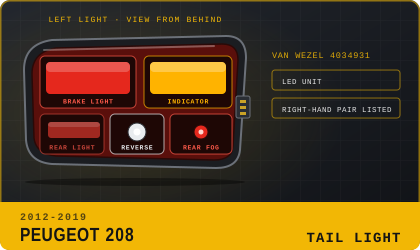 Illustration for editorial purposes
Opens live listings in a new tab.
OEM Part Number: confirm via VIN
Aftermarket rear lamps: Van Wezel 4034931 / Diederichs 4227091
| Tail lights (aftermarket) | Van Wezel 4034931 (left, without bulb holder, right-hand pair 4034932); Diederichs 4227091 (left, LED); Alkar 2221286 (left, LED, without bulb holder, right-hand pair 2222286); Hella 2SK354834-011 (left, LED, with bulb holder) |
|---|---|
| Genuine (OE) numbers quoted | None quoted in the catalogue listings — the genuine light varies by trim, bulb or LED type and facelift date, so order it against your VIN |
| Fitment notes | Left and right are separate parts; check LED or bulb type, whether the bulb holder is included, body style and facelift date before ordering. |
Vented lamps and too much moisture on the 208
Modern light units are deliberately vented rather than fully sealed, meaning some condensation forming and clearing naturally is by design rather than a fault. That said, one documented 208 case is useful to know about directly: an owner of a nearly-new car found condensation covering almost half the visible area inside the headlamp after driving or standing in rain, and was told by the dealer this was normal, with an official Peugeot document produced supporting the claim that unsealed lamps are designed this way with no risk to corrosion or lighting effectiveness. The owner's own skeptical observation is worth repeating: this kind of blanket "designed to vent" explanation can be used to dismiss excessive water ingress just as easily as it explains normal, minor misting — comparing your car against another example of the same model is a more useful test than accepting the explanation alone.
Note too that water ingress issues on this platform aren't limited to the lights themselves — blocked scuttle drains under the windscreen wipers are a separate, well-documented cause of water finding its way into the car more broadly, sometimes affecting the BSI (the car's central electrical control module) if it reaches wiring connectors. If you're chasing condensation or dampness beyond just the lights, it's worth checking these drains too rather than assuming every water-related fault traces back to a single cause.
Why the 208's rear lamps are part of a wider circuit
The Peugeot 208's tail light units do a lot in a small space, typically bundling brake, indicator, reversing and rear fog light functions together — so when something goes wrong electrically, more than one function can fail at once, and "faulty tail light" is rarely a precise diagnosis on its own.
Watch: replacing it
Inside the 208's rear lamp cluster
Beyond basic rear visibility, tail light units on the 208 typically integrate brake lights, indicators, reversing lights and rear fog lights into a single housing. Higher trims may use LED units with a distinct light signature, which are not interchangeable with standard halogen units even if the physical mounting looks similar.
Fitment and compatibility Generations and Lamp Type| Standard trims | Halogen bulb-based units as standard |
|---|---|
| Higher trims, later model years | LED tail lights become available further up the range, a different assembly and connector from the halogen units on lower trims |
Tail light design changed between generations of the 208, and facelifted versions within the same generation often use a revised light signature that isn't interchangeable with pre-facelift units. Always confirm the exact part for your specific model year before ordering. Whether you're sourcing a replacement tail lights for your Peugeot 208 from a dealer, specialist, or online marketplace, always check compatibility against your registration or VIN before buying, and confirm you're ordering the correct side — driver's side (RH in the UK) or passenger side (LH in the UK) — since these are not interchangeable.
Opens live listings in a new tab.
These are the same regardless of make or model — see our full Tail Lights Guide for diagnosing which circuit has failed, how easy this job is to DIY, and aftermarket advice.
The same part on other modelsThe same part, covered across other Peugeot models.