
Peugeot 308 Spark Plugs: Intervals, Fitment & Warning Signs
On the 308, a real phenomenon on the 1.2 PureTech engine explains knocking under load — plus real plug part number confusion worth checking.
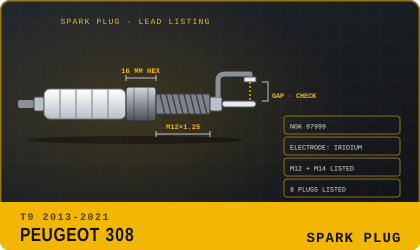 Illustration for editorial purposes
Opens live listings in a new tab.
OEM Part Number: confirm via engine code
Aftermarket plugs: NGK 97968 / Bosch 0 242 140 543
| Petrol engines in this generation | 1.2 THP 110 and 131 HP, 1.2 VTi 82 HP, 1.6 VTi 115 HP, 1.6 THP 125, 150, 152, 156 and 163 HP, 1.6 PureTech 225 HP, 1.6 GT 205 HP, 1.6 GTi 250 HP, 263 HP (L3EGXP) and 272 HP (L35GNH), 1.6 Flex 173 HP (petrol/ethanol) |
|---|---|
| Spark plugs (aftermarket) | NGK 97968 (iridium, 14 mm bi-hex, M12x1.25); NGK 91530 (platinum, 14 mm bi-hex, M12x1.25); NGK 97999 (iridium, 16 mm hex, M12x1.25); NGK 90909 (iridium, 16 mm hex, M12x1.25); NGK 6677 (nickel, 16 mm hex, M14x1.25); Bosch 0 242 140 543 (0.75 mm gap, 14 mm hex, M12x1.25); Bosch 0 242 145 607 (0.8 mm gap, 14 mm hex, M12x1.25); Bosch 0 242 145 535 (0.75 mm gap, 14 mm hex) |
| Genuine (OE) numbers quoted | Denso VXUH22I cross-references A0041592503 |
| Fitment notes | Two thread families appear. The 1.2 and 1.6 THP and PureTech engines use M12x1.25 iridium or platinum plugs, while the older 1.6 VTi and similar engines use M14x1.25 (16 mm hex) plugs in nickel, copper or iridium. Check the engine before ordering. No change interval is shown. |
Low-speed pre-ignition on turbo PureTech engines
If your car has a PureTech turbocharged petrol engine and you're experiencing a knocking or misfiring sensation under load at low engine speed, about Low Speed Pre-Ignition (LSPI) — an industry-recognised phenomenon affecting small, turbocharged direct-injection engines generally, not something unique to Peugeot. It occurs when the fuel-air mixture ignites prematurely, before the spark plug fires, causing a knock that can potentially damage the engine over time if it happens repeatedly. Useful to know: LSPI is understood to be exacerbated by certain oil additive packages, and switching to an oil that meets the correct, current specification for this engine — combined with using a higher-octane fuel, which some owners report noticeably reduces the frequency of the knock — are the cheapest, simplest first steps worth trying.
A small part behind big symptoms on the 308
On the Peugeot 308, there's rarely a clear signal when spark plugs wear out — just a rougher idle, marginally less pep off the line — vague enough to get pinned on other engine issues. Since the part costs so little, it's also one of the easiest things to keep putting off.
Watch: replacing them308 Mk1 (T7); no T9-specific English video found, French 308 option https://www.youtube.com/watch?v=6Dz8x35DfFo (generation unverified)

Coil, plug and cylinder: the 308's ignition chain
On the Peugeot 308, combustion efficiency, fuel economy and smooth running all trace back to spark plug condition, since these are what ignite the compressed fuel-air mixture in each cylinder. Petrol engines depend on them entirely — diesels skip spark plugs altogether, igniting fuel through compression instead.
Generations, Engines and Plug Count| Diesel variants (BlueHDi) | Not applicable — diesel engines use compression ignition and have no spark plugs at all |
|---|---|
| 1.2 PureTech/THP (standard petrol trims) | only 3 spark plugs — this engine is shared across the wider PSA/Stellantis range (Peugeot, Citroen, DS), not a four-cylinder |
| GTI/GT (1.6 THP, where fitted) | 4 spark plugs — the performance derivative uses a different, larger four-cylinder engine from the standard car's 3-cylinder unit |
Opens live listings in a new tab.
These are the same regardless of make or model — see our full Spark Plugs Guide for symptoms of worn plugs, why matching your exact plug specification matters, and trusted brands to buy from.
The same part on other modelsThe same part, covered across other Peugeot models.