
Renault Clio Tail Lights: Specs, Fitment & Common Faults
A dealer reportedly waited for a warranty to expire before treating condensation as serious — plus confirmation this affects even brand-new cars, not just older ones.
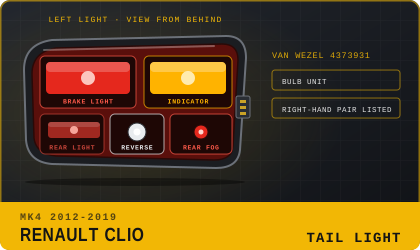 Illustration for editorial purposes
Opens live listings in a new tab.
OEM Part Number: confirm via VIN
Aftermarket rear lamps: Van Wezel 4373931 / TYC 11-12356-11-2
| Tail lights (aftermarket) | Van Wezel 4373931 (left, without bulb holder, to 2016, outer section, right-hand pair 4373932); TYC 11-12356-11-2 (left, without bulb holder); Diederichs 4416191 (left, without bulb holder); Alkar 2221187 (left, without bulb holder, outer section, right-hand pair 2222187) |
|---|---|
| Genuine (OE) numbers quoted | None quoted in the catalogue listings — the genuine light varies by trim, bulb or LED type and facelift date, so order it against your VIN |
| Fitment notes | Left and right are separate parts; check LED or bulb type, whether the bulb holder is included, body style and facelift date before ordering. |
Don't let the warranty run out on a damp Clio lamp
If you notice light condensation while your car is still within warranty, this is worth acting on promptly rather than waiting: one case saw a Clio owner's running light found "full of condensation" during a service on the very last day of a four-year warranty, only to be told by the dealer it "wasn't bad enough yet" to warrant fixing, and that it would "clear up once the warmer weather comes." If you notice genuine condensation building inside any light unit while still covered, it's worth raising it formally and in writing as early as possible, rather than waiting for a routine service that might fall right at the edge of your cover.
A useful benchmark worth knowing: light condensation that clears within around 3 hours of normal driving is widely considered a normal characteristic of vented light units, but condensation that's noticeably worse after pressure washing specifically, or that persists well beyond this, is worth investigating for a genuine seal fault rather than accepted as inevitable. Also, rear light clusters are often open to the atmosphere by design around the bulb fittings — check whether one side is consistently worse than the other, since both sides being open equally but only one clouding up points toward a specific seal fault on that side rather than the design itself.
More than a lens: the Clio's rear lamp assembly
Because brake light, indicator, reversing light and rear fog light are usually combined in one Renault Clio tail light housing, a single electrical fault can knock out more than one function at once — which is why this particular complaint rarely means just one thing.
Watch: replacing it
How the Clio signals to traffic behind
Beyond basic rear visibility, tail light units on the Clio typically integrate brake lights, indicators, reversing lights and rear fog lights into a single housing. Higher trims may use LED units with a distinct light signature, which are not interchangeable with standard halogen units even if the physical mounting looks similar.
Fitment and compatibility Generations and Lamp Type| Standard trims | Halogen bulb-based units as standard |
|---|---|
| Higher trims, later model years | LED tail lights become available further up the range, a different assembly and connector from the halogen units on lower trims |
Tail light design changed between generations of the Clio, and facelifted versions within the same generation often use a revised light signature that isn't interchangeable with pre-facelift units. Always confirm the exact part for your specific model year before ordering. Whether you're sourcing a replacement tail lights for your Renault Clio from a dealer, specialist, or online marketplace, always check compatibility against your registration or VIN before buying, and confirm you're ordering the correct side — driver's side (RH in the UK) or passenger side (LH in the UK) — since these are not interchangeable.
Opens live listings in a new tab.
These are the same regardless of make or model — see our full Tail Lights Guide for diagnosing which circuit has failed, how easy this job is to DIY, and aftermarket advice.
The same part on other modelsThe same part, covered across other Renault models.