
Seat Arona Cabin Air Filter: Intervals, Fitment & Warning Signs
On the Arona, official installation guides can genuinely differ between generations — worth confirming yours before starting, plus a genuine spray treatment for musty smells.
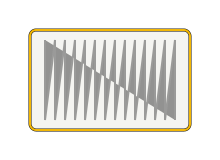 Illustration for editorial purposes
Opens live listings in a new tab.
OEM Part Number: 6R0820367
| Standard particulate filter | Seat OEM: 6R0819644 — shared with the current-generation Ibiza and related VW Polo variants |
|---|---|
| Activated carbon/charcoal filter | Seat OEM: 6R0819653 (also cross-referenced as 6R0820367) — a genuinely different filter media from the standard version |
A Genuine Warning: Even Official Guides Can Be Wrong for Newer Models — Seat Arona Cabin Air Filter
Worth knowing before following a generic guide: access location and method has genuinely changed between generations on this platform, and it's not just owner confusion — even official manufacturer installation documentation has been confirmed incorrect for newer models in at least one documented case, where a Mann Filter installation guide correctly described the process for an older Ibiza generation but was flagged by multiple owners as simply wrong for the newer, post-2017 model. Older models (broadly pre-2017) are typically accessed behind the glovebox, secured by a small rectangular cover with a few screws; confirm you're following a guide specific to your actual generation before assuming a general "SEAT Ibiza" guide applies.
Seat Arona Cabin Air Filter: Easy to Forget, Easy to Fix
There's no performance downside to a neglected Seat Arona cabin filter, which is precisely the problem: nothing about how the car drives will tell you it needs changing, so it often gets forgotten until a musty smell or weak airflow forces the issue.
Seat Arona Cabin Air Filter: What It Does
Don't confuse this with the Seat Arona's engine air filter — they're unrelated parts. The cabin filter's job is cleaning air before it reaches the ventilation system, catching dust and pollen, with activated-carbon versions also filtering some airborne odours.
Opens live listings in a new tab.
Seat Arona Cabin Air Filter: Warning Signs, DIY Difficulty & Aftermarket Advice
These are the same regardless of make or model — see our full Cabin Air Filter Guide for signs it needs changing, confirming fitment against your VIN, and choosing standard, carbon, or HEPA media.
More Seat Cabin Air Filter
The same part, covered across other Seat models.