
Seat Leon Exhaust System: Specs, Fitment & Common Faults
If your Leon had the Dieselgate emissions software update, a documented pattern links it to EGR failures afterward — including real fault codes and a genuine technical explanation.
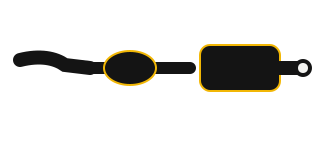 Illustration for editorial purposes
Opens live listings in a new tab.
OEM Part Number: confirm via VIN — Rear silencer (aftermarket) Bosal 233-607 / Walker 21950
| Rear silencer (back box) — aftermarket | Bosal 233-607, 154-317, 154-511 (accessories); Walker 21950 (530 mm), 22059 (810 mm), 21953 (640 mm); Ernst 112215 (780 mm); Asmet 03.097, 03.086, 07.174; MTS 01.95530 (740 mm), 01.69030 (820 mm), 01.69080 (1000 mm); Vegaz SES-139, FTS-5, VS-352AT; Polmo 08.585, 08.399, 08.671, 23.68, 23.70 |
|---|---|
| Centre / intermediate silencer — aftermarket | Bosal 105-109, 105-111 (accessories); Walker 21575 (790 mm), 21576 (800 mm), 21903 (850 mm); Ernst 153003, 202022, 155175 (920 mm); MTS 01.59790, 01.59800, 01.59810; Vegaz AS-165, VS-293, VS-293AT, VS-293IMA (880 mm), VS-295; Polmo 01.104, 01.106, 30.233; Izawit 15.009, 23.034 |
| Front pipe / catalytic converter (DPF on diesels) — aftermarket | Bosal 090-285 (Euro 5), 099-547 (Euro 4); AS 33802D (Euro 5, 350 mm); NAP CAD10671 (Euro 5, 350 mm); BM Catalysts BM31200H (SCR Euro 6) plus Euro 4 ones; JMJ 1091248 (BCB/BCA), 1091391 (BSF/BSE/BGU), 1090854 (AXP, AHW, APE, BCA, AZD...) and older ones; Walker 20630 (620 mm); Vegaz VK-976AT (up to Euro 4). |
| Genuine (OE) numbers quoted | None quoted in catalogue listings — order genuine parts against your VIN |
| Fitment notes | Engines: 1.0 TSI to 2.0 Cupra, 1.6/2.0 TDI, CNG 1.4 TGI / 1.5 TGI. Cat list is mixed with older VW/Audi parts. |
Worth Knowing: A Documented Link Between the Emissions Fix and EGR Failure
Worth understanding if you own a diesel SEAT that received the emissions compliance software update following the 2015 "Dieselgate" scandal: a genuinely documented, real case describes a 2011 Ibiza that ran fine for a period after the update, then developed a rough idle in first gear, an intermittent engine management light, and finally broke down completely in the middle of traffic — diagnosed by breakdown recovery as an EGR valve fault. Specific fault codes reported in connection with this pattern include P0407 and P046C, both relating to EGR sensors. The suggested technical explanation is that the software update commands the EGR valve to positions it was never previously asked to reach, accelerating wear and failure in valves that were coping fine under the original software calibration.
Separately, and relevant regardless of whether the emissions update applies to your specific car: a blocked DPF is overwhelmingly a short-journey problem — the filter needs sustained running at higher revs for around 20 miles to regenerate properly, and a diesel used mainly for short, low-speed trips may never complete this cycle, leading to warning lights, limp mode, and eventually a blockage requiring active intervention.
Seat Leon Exhaust System: The Part That Announces Its Own Problems
On the Seat Leon, this is one of the few parts where your ears will catch a problem before your eyes do — a new rattle, a drone, noise that simply wasn't there a week ago. That's a genuine advantage, since it gives you an early warning most other faults don't offer.
Seat Leon Exhaust System: Watch: Replacing It
Rear muffler/back box swap on a Mk3 5F

Seat Leon Exhaust System: What It Does
On the Seat Leon, burnt gases leave the engine through the exhaust system, which quiets them via the silencer and treats emissions through a catalytic converter and particulate filter before anything exits the tailpipe. Petrol and diesel versions frequently use entirely different systems, since their emissions treatment needs aren't the same.
Opens live listings in a new tab.
Seat Leon Exhaust System: Warning Signs, DIY Difficulty & Aftermarket Advice
These are the same regardless of make or model — see our full Exhaust System Guide for warning signs and fault codes to watch for, confirming fitment against your VIN, and which aftermarket brands are worth trusting.
More Seat Exhaust System
The same part, covered across other Seat models.