
Subaru Outback Exhaust System: Specs, Fitment & Common Faults
Confirmed: a genuine safety recall addresses the front exhaust pipe assembly potentially cracking from a stressful installation condition — plus a real diagnostic technique for confirming genuine restriction before assuming P0420 means the converter has failed.
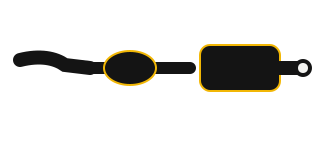 Illustration for editorial purposes
Opens live listings in a new tab.
Subaru Outback Exhaust System: OEM Part Number
| Left-bank exhaust manifold with catalytic converter | Subaru's horizontally-opposed "boxer" engine genuinely has two separate cylinder banks, each with its own manifold and catalytic converter — this is a distinctly different physical layout from an inline engine's single manifold, and the left and right units are not interchangeable |
|---|---|
| Right-bank exhaust manifold with catalytic converter | A genuinely separate part from the left-bank unit above — both banks feed into the shared downstream system, but each has its own dedicated cat |
| Centre/intermediate pipe | The section where both cylinder banks' exhaust streams merge into a single pipe, genuinely separate from the twin front manifolds and the rear silencer |
| Rear silencer | Confirm your exact engine and trim, since Subaru used multiple distinct rear silencer references across most model generations — Symmetrical All-Wheel Drive is standard across nearly the whole range, so there's no separate FWD-specific silencer to worry about on most models |
Subaru Outback Exhaust System: The Part That Announces Its Own Problems
On the Subaru Outback, you'll typically hear this fault developing long before you'd ever see it — a new rattle, an odd drone, noise levels creeping up from one week to the next. That early audible warning is a genuine head start on catching the problem before it worsens.
Subaru Outback Exhaust System: What It Does
The Subaru Outback's exhaust does more than just carry gases away from the engine — it also handles noise reduction through the silencer and emissions treatment via a catalytic converter and particulate filter. That's why petrol and diesel versions can use entirely different systems.
Opens live listings in a new tab.
Confirmed: A Genuine Safety Recall Worth Checking Your Car Against — Subaru Outback Exhaust System
This is genuinely worth checking directly if your catalytic converter or front exhaust pipe has cracked: Subaru has issued a confirmed recall addressing the front exhaust pipe assembly, which may have been installed under a stressful condition during manufacturing that can lead to cracking over time. If a dealer tells you the catalytic converter or the pipe internally has cracked, particularly on a car still reasonably close to the end of its standard warranty, it's genuinely worth checking whether this specific recall applies to your VIN before assuming you'll need to pay for the repair yourself.
It's also genuinely worth knowing that replacing a catalytic converter without first identifying and fixing whatever actually damaged it — commonly a poor battery or earth connection, a vacuum leak, a separate exhaust leak, or a faulty sensor — will very likely result in the replacement failing again in exactly the same way within months.
Subaru Outback Exhaust System: Warning Signs, DIY Difficulty & Aftermarket Advice
These are the same regardless of make or model — see our full Exhaust System Guide for warning signs and fault codes to watch for, confirming fitment against your VIN, and which aftermarket brands are worth trusting.
More Subaru Exhaust System
The same part, covered across other Subaru models.