
Suzuki Ignis Cabin Air Filter: Intervals, Fitment & Warning Signs
On the Ignis, spraying disinfectant into the recirculate air intake behind the glovebox tackles musty smells that a fresh filter alone doesn't fully resolve.
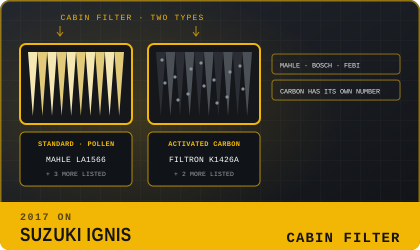 Illustration for editorial purposes
Opens live listings in a new tab.
OEM Part Number: confirm via VIN
Aftermarket pollen filters: Mahle LA1566 / Bosch 1987435161
| Cabin filter, standard (aftermarket) | Mahle LA1566, Bosch 1987435161, Febi 183880, Blue Print ADK82516 |
|---|---|
| Activated-carbon version (aftermarket) | Filtron K1426A, Purflux AHC755, Corteco 49412333 |
| Genuine (OE) number | Not quoted in the catalogue listings — the fitted filter varies by trim and build date, so order the genuine one against your VIN |
| Fitment notes | Standard and carbon filters have different numbers, and the right size depends on trim and build date. Check which type your car was built with before ordering. |
Fresh air in the Ignis for the price of a small part
Of everything covered for the Suzuki Ignis, this is about as low-stakes mechanically as it gets — it doesn't touch how the car drives at all. Its only job is cabin air quality, which is exactly why owners tend to ignore it until something makes that hard to do.
Where the incoming air is filtered on the Ignis
On the Suzuki Ignis, this filter sits in the ventilation intake, not the engine bay, and cleans the air reaching the cabin — trapping dust, pollen, and on carbon-activated versions, some odours and pollutants too. The engine air filter is a completely different part, serving combustion rather than the cabin.
Watch: replacing it
Opens live listings in a new tab.
Treating a sour AC smell
If you're dealing with a musty or sour smell that a fresh filter alone doesn't fully resolve, spraying a disinfectant directly into the recirculate air intake, typically located behind the glovebox on most Suzuki models, with the fan running on a high setting for five to ten minutes, has been documented as an effective way to tackle this kind of smell at its source.
Also, debris such as leaves and grass commonly accumulates on top of the filter itself over time, and this debris can be a source of bad odours in its own right, separate from the filter media degrading — worth checking for and clearing this debris during any filter change.
Warning signs, DIY difficulty and aftermarket adviceThese are the same regardless of make or model — see our full Cabin Air Filter Guide for signs it needs changing, confirming fitment against your VIN, and choosing standard, carbon, or HEPA media.
The same part on other modelsThe same part, covered across other Suzuki models.