
Suzuki Swift Battery: Specs, Fitment & Common Faults
A proximity key stored too close to the car, even inside the house, can be detected and keep it electronically awake — plus a hidden, cracked negative terminal that caused a persistent charging fault.
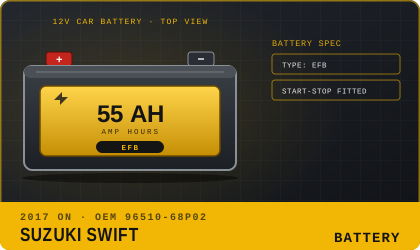 Illustration for editorial purposes
Opens live listings in a new tab.
OEM Part Number: 96510-68P02
| 2017-2022 MK4, 1.0 petrol, genuine Start/Stop lithium battery reference | Suzuki OEM: 96510-68P02 (also referenced as 210500-0062) |
|---|---|
| Confirmed genuine fitment (2018 SZ5 1.0 Boosterjet, physically measured) | Type 012 EFB, 55Ah, 480 CCA — label reads "LB542, 20HR 55aH, CCA 450A, LN1" |
| Earlier generation, non-Start/Stop, confirmed genuine fitment | Type 063, genuine VARTA reference 33610-83E51 |
Why a new 12V unit doesn't always fix a flat Swift
When a Suzuki Swift won't start, the battery is the first suspect more often than anything else, and it's right often enough that checking it first is a reasonable move. It isn't always the actual cause though, so check this before paying for a replacement that solves nothing.
How the Swift stores and supplies electrical power
Starting the engine and running electrical systems whenever the engine isn't turning — that's the Suzuki Swift's 12V battery job. If it has stop-start, it works much harder than older designs, since the engine cuts out and restarts constantly, which is exactly why it needs a specific AGM or EFB battery rather than a standard one.
Watch: replacing itFilmed on a Swift.

Opens live listings in a new tab.
A proximity key near the car that keeps it awake
If your Swift Hybrid keeps going flat and you keep your proximity key inside the house near an integral garage, one case saw exactly this pattern, with the owner noticing the car's proximity sensor lighting up even in the dark simply from them walking nearby — suggesting the car can detect the key through the garage wall and stay partially awake trying to communicate with it, draining the battery over time. If your key is normally stored close to where the car is parked, it's worth moving it further away and seeing if this resolves a repeated flat battery before assuming a more complex electrical fault.
Normal parasitic drain with everything switched off and the car unalarmed should measure around 0.05 amps (50 milliamps) — if you're measuring meaningfully higher than this with a multimeter, it's worth removing fuses one at a time and re-measuring after each to isolate exactly which circuit is responsible, rather than guessing at the cause.
Warning signs, DIY difficulty and aftermarket adviceThese are the same regardless of make or model — see our full Battery Guide for warning signs to watch for, confirming fitment against your VIN, and matching the right technology (standard, EFB, AGM) when buying aftermarket.
The same part on other modelsThe same part, covered across other Suzuki models.