
Toyota Corolla Spark Plugs: Intervals, Fitment & Warning Signs
A genuinely valuable diagnostic technique: swapping a coil to a different cylinder reveals whether it's genuinely faulty — plus a money-saving clarification about when coils actually need replacing.
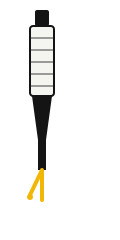 Illustration for editorial purposes
Opens live listings in a new tab.
A Genuinely Valuable Diagnostic Technique Worth Knowing
If you're getting a persistent misfire fault code pointing to a specific cylinder and want to confirm whether the coil itself is genuinely at fault, this is worth trying before replacing parts on a hunch: physically swap the coil from the suspect cylinder with a coil from a different cylinder position, then clear the codes and drive again. If the fault code now follows the coil to its new position, the coil itself is genuinely faulty. If the fault code stays associated with the original cylinder position instead, the coil isn't the problem, and it's worth looking at the wiring, connector, or the cylinder itself rather than replacing more coils speculatively.
It's also worth knowing about a genuinely real, somewhat distinctive pattern: an intermittent misfire that seems to worsen specifically in wet weather, and settles down or clears entirely after sitting in a dry garage overnight, often points toward moisture affecting a connector or the coil itself rather than a genuine fault with the coil or plug as components. Checking connectors for corrosion or a compromised seal is worth doing before continuing to replace coils and plugs that may not actually be at fault.
Toyota Corolla Spark Plugs: A Cheap Part That Causes Expensive-Feeling Problems
Worn spark plugs on the Toyota Corolla rarely announce themselves clearly — a slightly rougher idle, a bit less punch off the line — symptoms easy to blame on almost anything else in the engine bay. The part itself costs very little, which makes it an easy one to overlook for far longer than it should be.
Toyota Corolla Spark Plugs: Watch: Replacing It
E210 generation (US-market 2.0 engine); UK 1.8/2.0 hybrid engines differ slightly.

OEM Part Number: confirm via engine code — aftermarket NGK 95029 / Bosch 0 242 140 565
| Petrol engines in this generation | 1.2 (NRE210) 116 HP; 1.2 4WD (NRE214H) 116 HP; 2.0 (MZEA12) 170 HP. Hybrids: 1.8 Hybrid (ZWE211) 122 HP; 2.0 Hybrid (MZEH12) 180/184 HP; 2.0 Hybrid (MZEH19) 196 HP |
|---|---|
| Spark plugs (aftermarket) | NGK 95029 (iridium, gap 0.9 mm, M12x1.25, hex 14); NGK 95202 (iridium, gap 0.8 mm, M12x1.25, hex 14); Bosch 0 242 140 565 (gap 0.7 mm, M12x1.25, hex 14); Bosch 0 242 140 572 (gap 0.65 mm, hex 14); Denso FC20HR-Q8 (iridium, platinum earth, M12x1.25); Denso FC16HR-Q8 (iridium, platinum earth); Denso EC22HPR-D7 (iridium, platinum earth); Champion CCH9412 (iridium, gap 1.0 mm) |
| Genuine (OE) numbers quoted | Denso FC20HR-Q8 = 90919-01297; Denso FC16HR-Q8 = 90919-01289; Denso EC22HPR-D7 = 90919-01295 |
| Fitment notes | Every plug listed is a 14 mm hex M12x1.25 iridium type; individual plugs are not tied to engine codes, so confirm by engine (the Denso FC20HR-Q8 / 90919-01297 reference is the one quoted alongside the Toyota number). No copper or laser plugs listed |
Genuine Toyota spark plugs use a dual ground electrode design that the manufacturer states lasts roughly twice as long as the single-electrode plugs commonly used by aftermarket competitors — worth factoring into any price comparison, since a cheaper plug that needs replacing twice as often isn't necessarily better value.
Toyota Corolla Spark Plugs: What They Do
The Toyota Corolla's spark plugs ignite the compressed fuel-air mixture inside each cylinder, and their condition directly affects combustion efficiency, fuel economy and smooth running. Petrol engines rely entirely on them; diesel engines don't use spark plugs at all, relying on compression instead.
Toyota Corolla Spark Plugs: Generations & Spark Plug Count
| Diesel variants | Not applicable — diesel engines use compression ignition and have no spark plugs at all |
|---|---|
| Petrol variants (all trims) | 4 spark plugs — one per cylinder |
Opens live listings in a new tab.
Toyota Corolla Spark Plugs: Warning Signs, DIY Difficulty & Aftermarket Advice
These are the same regardless of make or model — see our full Spark Plugs Guide for symptoms of worn plugs, why matching your exact plug specification matters, and trusted brands to buy from.
More Toyota Spark Plugs
The same part, covered across other Toyota models.