
Vauxhall Zafira Tourer Spark Plugs: Intervals, Fitment & Warning Signs
On the Zafira Tourer, two internally different versions of the genuine coil pack look identical externally — fitting the wrong one causes rapid re-failure.
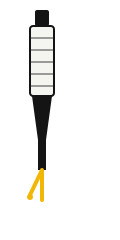 Illustration for editorial purposes
Opens live listings in a new tab.
OEM Part Number: 1214016 (as quoted in catalogue listings — confirm via engine code) — aftermarket NGK 2477 / Bosch 0 242 235 912
| Petrol engines in this generation | 1.4 (120 hp), 1.4 (140 hp), 1.6 SIDI (170 hp), 1.6 SIDI (200 hp), 1.8 (116 hp), 1.8 (140 hp), 1.6 CNG (150 hp, petrol/CNG) |
|---|---|
| Spark plugs (aftermarket) | NGK 2477 (iridium, M14x1.25, 19 mm reach, 16 mm hex); NGK 91039 (iridium, M14x1.25, 16 mm hex); NGK 91970 (iridium, M12x1.25, 25 mm reach, 14 mm hex); Bosch 0 242 235 912 (0.9 mm gap, M14x1.25, 16 mm hex); Bosch 0 242 240 707 (0.7 mm gap, M14x1.25); Bosch 0 242 236 571 (0.7 mm gap, M14x1.25); Denso IK16TT, IK20TT and IK22FTT (iridium with platinum, M14x1.25); Beru Z376 (iridium/platinum, 0.7 mm gap, M12x1.25, 25 mm reach) |
| Genuine (OE) numbers quoted | Denso KJ20CR-L11 quoted against OE 1214016; Denso KJ16CR-L11 quoted against OE 101-905-601B |
| Fitment notes | Plugs are listed per engine group rather than per engine code; the M14x1.25 16 mm hex family is the main fit, with the M12x1.25 long-reach 14 mm hex plugs (NGK 91970, Beru Z376) for the turbo 1.6 SIDI engines; no change interval shown. |
A Genuine Fitment Trap Worth Knowing First — Vauxhall Zafira Tourer Spark Plugs
If you're replacing a coil pack, this is genuinely worth knowing beforehand: genuine Vauxhall coil packs exist in two internally different versions that look externally identical, and fitting the wrong one for your specific car results in premature failure shortly after fitting — a pattern reported repeatedly by owners who've replaced a coil pack only to have it fail again within a very short time. Always confirm the exact, correct part reference for your specific engine and build date via your VIN rather than assuming any coil pack that physically fits the socket is the right one.
Vauxhall Zafira Tourer Spark Plugs: A Cheap Part That Causes Expensive-Feeling Problems
On the Vauxhall Zafira Tourer, there's rarely a clear signal when spark plugs wear out — just a rougher idle, marginally less pep off the line — vague enough to get pinned on other engine issues. Since the part costs so little, it's also one of the easiest things to keep putting off.
Vauxhall Zafira Tourer Spark Plugs: Watch: Replacing It
Astra J shares the Zafira Tourer C platform and petrol engines; no Tourer plug video found.

Vauxhall Zafira Tourer Spark Plugs: What They Do
On the Vauxhall Zafira Tourer, combustion efficiency, fuel economy and smooth running all trace back to spark plug condition, since these are what ignite the compressed fuel-air mixture in each cylinder. Petrol engines depend on them entirely — diesels skip spark plugs altogether, igniting fuel through compression instead.
Vauxhall Zafira Tourer Spark Plugs: Generations & Spark Plug Count
| Diesel variants | Not applicable — diesel engines use compression ignition and have no spark plugs at all |
|---|---|
| Petrol variants (all trims) | 4 spark plugs — one per cylinder |
Opens live listings in a new tab.
Vauxhall Zafira Tourer Spark Plugs: Warning Signs, DIY Difficulty & Aftermarket Advice
These are the same regardless of make or model — see our full Spark Plugs Guide for symptoms of worn plugs, why matching your exact plug specification matters, and trusted brands to buy from.
More Vauxhall Spark Plugs
The same part, covered across other Vauxhall models.