
Volvo XC90 Fuel Pump: Specs, Fitment & Common Faults
Confirmed: two genuine safety recalls — a fuel line that could crack and leak into the engine bay, plus a fuel pump fuse recall — with a money-saving tip that could save hundreds versus an unnecessary control module replacement.
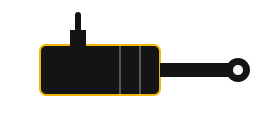 Illustration for editorial purposes
Opens live listings in a new tab.
OEM Part Number: 31372614 (genuine feed unit — confirm via VIN, as drive and fuel variants exist)
| Fuel pumps / feed units (aftermarket) | Volvo 31372614 (genuine electric feed unit, XC90 2016-on, also S90/V90/V90 CC and XC60 2018-on, not for USA/Canada cars, EUR 634.88); Volvo 31372615 (genuine feed unit, XC90 2016-on, also V60 2019-on, V60 CC, V90 CC and XC60 2018-on). |
|---|---|
| Types & variants | neither is sold as a bare pump. |
| Genuine (OE) numbers quoted | 31372614; 31372615 |
| Fitment notes | Check the variant code before buying, and order the matching gasket (Volvo 31380341) and locking ring (Volvo 31274203), both sold separately. |
Volvo XC90 Fuel Pump: A Part That Fails at the Worst Possible Moments
On the Volvo XC90, few faults pick a worse moment to happen than this one, which has a habit of leaving drivers stranded mid-journey rather than failing safely at home. Catching the early signs gives you a genuine head start before that happens to you.
Volvo XC90 Fuel Pump: What It Does
On the Volvo XC90, fuel reaches the engine at the pressure combustion needs thanks to the fuel pump, which draws it straight from the tank. It sits submerged inside the tank itself, and that positioning is a big part of why replacement takes more effort than the part's size would suggest.
Volvo XC90 Fuel Pump: Generations & Engines: Fuel Pump Type
| P1/P3 platform (pre-2015), D3/D4/D5 diesel, D-family & T-family petrol | Spans both diesel (in-tank lift pump plus an engine-mounted high-pressure pump) and petrol (in-tank low-pressure pump, plus a separate high-pressure pump if direct-injection) variants — confirm your exact engine before ordering |
|---|---|
| SPA platform (2015–present), VEA 2.0L petrol/diesel/hybrid, T5/T6/T8 | Spans both diesel (in-tank lift pump plus an engine-mounted high-pressure pump) and petrol (in-tank low-pressure pump, plus a separate high-pressure pump if direct-injection) variants — confirm your exact engine before ordering — the hybrid system doesn't change this; the combustion engine still needs its own fuel pump |
Volvo XC90 Fuel Pump: Watch: Replacing It
First-gen XC90; SPA (2015+) results were injector/pressure sensor only

Opens live listings in a new tab.
Confirmed: Two Genuine Safety Recalls Worth Checking Your Car Against — Volvo XC90 Fuel Pump
This is genuinely worth checking directly, particularly on a 2015-2016 diesel model: a confirmed UK recall covered 30,777 cars where a fuel line could develop small cracks, potentially leading to fuel leaking into the engine bay. Separately, a confirmed recall covering certain 2019-2020 models addressed the low-pressure fuel pump's 15-amp fuse, which could blow due to an electrical current spike, causing the engine to stall or fail to start. The official fix was to replace the 15-amp fuse with a more robust 20-amp fuse, free of charge.
It's also genuinely worth knowing that a used fuel pump control module must be professionally programmed and electronically matched to your car's specific VIN and immobiliser system — it isn't a simple plug-and-play replacement.
Volvo XC90 Fuel Pump: Warning Signs, DIY Difficulty & Aftermarket Advice
These are the same regardless of make or model — see our full Fuel Pump Guide for symptoms to watch for (including the low-pressure vs high-pressure distinction on direct-injection engines), confirming fitment against your VIN, and OE suppliers worth knowing.
More Volvo Fuel Pump
The same part, covered across other Volvo models.