
Volkswagen Polo Brake Discs: Specs, Fitment & Wear Symptoms
On the Polo, VW's own OEM discs have a documented reputation for corroding faster than quality aftermarket alternatives — plus why rear discs corrode faster than they should.
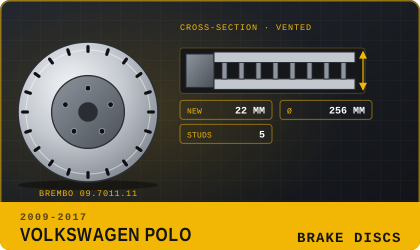 Illustration for editorial purposes
Opens live listings in a new tab.
OEM Part Number: confirm via VIN
Aftermarket front discs: Brembo 09.7011.11 / Bosch 0 986 478 853
| Front brake discs (aftermarket) | Brembo 09.7011.11 (256 x 22 mm, vented, 5 holes, coated, high-carbon, min 19 mm); Bosch 0 986 478 853 (256 x 22 mm, vented, 5 holes, coated, high-carbon, min 19 mm, ECE-R90); ATE 24.0122-0151.1 (256 x 22 mm, vented, 5 holes, coated, high-carbon, min 19.0 mm); TRW DF2803 (256 x 22 mm, vented, 5 holes, painted black, high-carbon, min 19 mm); Bosch 0 986 478 867 (288 x 25 mm, vented, 5 holes, coated, high-carbon, min 22 mm, ECE-R90); ATE 24.0125-0113.1 (288 x 25 mm, vented, 5 holes, coated, high-carbon, min 22.0 mm); Brembo 09.7010.76 (288 x 25 mm, vented, slotted, 5 holes, coated, high-carbon, min 22 mm) |
|---|---|
| Disc sizes & variants | Two front sizes are listed, 256 x 22 mm and 288 x 25 mm, both vented and five-stud. The 256 mm disc is the standard fitment on the small petrol and diesel engines; the 288 mm disc is the larger fitment used on the higher-output cars such as the GTI and the more powerful TDI/TSI models. |
| Genuine (OE) numbers quoted | None quoted in catalogue listings — order genuine discs against your VIN |
| Fitment notes | Minimum thickness is 19 mm for the 256 mm disc and 22 mm for the 288 mm disc. The Ridex 82B0004 is marked as usable only on cars built up to November 2016. |
When an MOT flags rusty rotors on a young Polo
Across VAG owner forums, one theme repeats with remarkable consistency: VW's own-brand OEM brake discs have a documented reputation for corroding and pitting considerably faster than quality aftermarket alternatives, particularly on the rear axle. Multiple owners who've switched to reputable aftermarket brands (Pagid and Napa Proformer both mentioned) report the corrosion problem disappearing entirely after fitting, suggesting this is more about VW's chosen disc material and coating than an inevitable characteristic of the car itself.
Note too that dealers frequently treat corrosion-related disc replacement as chargeable "wear and tear" excluded from warranty or maintenance plans, even on cars just a couple of years old with low mileage — but this isn't always the final word. Real cases exist of owners successfully obtaining a refund after VW head office intervened following a formal written complaint, when a local dealer initially refused to honour a maintenance plan covering brake repairs. If you believe corrosion this early reflects a material issue rather than ordinary wear, escalating in writing to VW customer services is a worthwhile step before accepting the dealer's first answer.
How the rotors turn speed into heat on the Polo
On the Volkswagen Polo, these two components wear together, and letting one go too long accelerates wear on the other, which is why a simple pad swap so often reveals discs that need replacing at the same time.
Watch: replacing themPolo 6R/6C era.
How the rotors stop the Polo
Brake discs provide the surface the brake pads clamp against to slow the car, converting momentum into heat through friction. Larger, sportier trims of the Polo typically use bigger discs than standard versions to handle the additional heat generated by more aggressive braking.
Opens live listings in a new tab.
These are the same regardless of make or model — see our full Brake Discs Guide for warning signs to watch for, confirming fitment against your VIN, and choosing a reliable aftermarket disc.
The same part on other modelsThe same part, covered across other Volkswagen models.