
Volkswagen Polo Fuel Pump: Specs, Fitment & Common Faults
A distinction for TSI/FSI petrol Polos, plus what diesel owners should know about a real metal contamination risk in the fuel pump.
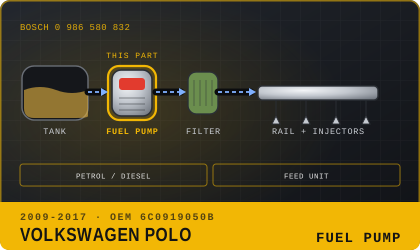 Illustration for editorial purposes
Opens live listings in a new tab.
OEM Part Number: 6C0919050B
As quoted in catalogue listings, confirm via VIN. Aftermarket units: Bosch 0 986 580 832 / Astemo 2503141
| Fuel pumps / feed units (aftermarket) | Bosch 0 986 580 832 (complete in-tank feed unit, electric); Delphi FG2423-12B1 (feed unit, no pressure sensor, supplied without gasket, 266 x 108 x 123 mm); Delphi FG2498-12B1 (feed unit, no pressure sensor, without gasket, 256 x 108 x 123 mm); Hella 8TF 358 106-431 (feed unit with sender, 5-pin, no system pressure regulator); Astemo 2503141 (feed unit with sender, diesel); Astemo 2503546 (feed unit with sender, diesel); Pierburg 7.07795.41.0 (feed unit, 0.5 bar, 12 V, 5.7 A, 2 connectors, 108.75 mm diameter, 229 mm long, a diesel lift unit); ERA 775712A (feed unit, 0.5 bar, 120 l/h, 5-pin, 12 V) |
|---|---|
| Types & variants | Diesel feed units run at about 0.5 bar (Pierburg 7.07795.41.0, ERA 775712A, Ridex 1382F0110, Astemo 2503141 and 2503546) and petrol feed units at 4 bar (Ridex 1382F0358 and 1382F0359, Hoffer 7507341). The two Delphi modules are petrol-type units without a built-in pressure sensor. The Hella 8TF 358 106-431 has no system pressure regulator, so it suits engines where the regulator sits elsewhere. |
| Genuine (OE) numbers quoted | 6C0919050B (Hoffer 7507341); none quoted for the Bosch, Delphi, Hella, Astemo, Pierburg, ERA or Ridex items. |
| Fitment notes | Petrol and diesel 6R/6C modules are distinct and the facelift 6C (2014 on) petrol unit carries the 6C0 prefix, so match the OE number on the old unit. All the main listings are complete feed units with sender rather than bare pump inserts, so the fuel gauge sender is replaced along with the pump. |
Why the Polo has two pumps working together
Modern VW petrol and diesel engines with direct injection use two separate fuel pumps working together: a low-pressure pump inside the tank (accessed from under the rear seat), and a high-pressure pump mounted on the engine itself. A whining noise from the rear seat area points to the in-tank low-pressure pump; hesitation, loss of power, or hard starting points more toward the engine-mounted high-pressure pump instead — correctly identifying which one is at fault matters, since the high-pressure pump is considerably more expensive to replace.
If your car is diesel-engined, metal filings (swarf) generated internally within a failing high-pressure pump can contaminate the entire fuel system — injectors, fuel lines, and the tank itself — turning what looks like a straightforward pump replacement into a full fuel system rebuild. Real cases have seen this escalate to repair bills in the thousands once contamination is confirmed throughout the system. If a high-pressure pump has failed on a diesel, insisting on a proper check of the injectors and fuel lines for metal contamination — rather than simply fitting a new pump and hoping for the best — is a worthwhile precaution, even though it adds to the initial cost.
Low-fuel driving and pump wear on the Polo
On the Volkswagen Polo, few faults pick a worse moment to happen than this one, which has a habit of leaving drivers stranded mid-journey rather than failing safely at home. Catching the early signs gives you a head start before that happens to you.
Watch: replacing it6R-specific

On the Volkswagen Polo, fuel reaches the engine at the pressure combustion needs thanks to the fuel pump, which draws it straight from the tank. It sits submerged inside the tank itself, and that positioning is a big part of why replacement takes more effort than the part's size would suggest.
How pump design differs across Polo engines
| 9N/9N3 (2002–2009), 1.2/1.4 petrol | Petrol: typically a single in-tank low-pressure pump; some later or higher-output variants may add a separate engine-mounted high-pressure pump for direct injection — confirm your exact engine |
|---|---|
| 9N3 GTI (2006–2008), 1.8T petrol | Petrol: typically a single in-tank low-pressure pump; some later or higher-output variants may add a separate engine-mounted high-pressure pump for direct injection — confirm your exact engine |
| 6R (2009–2014), 1.2 TSI petrol (EA111, CBZC/CBZB) | Petrol (direct injection): in-tank low-pressure pump plus a separate engine-mounted high-pressure pump |
| 6R GTI (2010–2014), 1.4 TSI twincharged (CAVE) | Petrol (direct injection): in-tank low-pressure pump plus a separate engine-mounted high-pressure pump |
| 6C facelift (2014–2017), 1.2 TSI petrol | Petrol (direct injection): in-tank low-pressure pump plus a separate engine-mounted high-pressure pump |
| AW/BZ (2017–present), 1.0/1.5 TSI petrol (EA211/EA211evo) | Petrol (direct injection): in-tank low-pressure pump plus a separate engine-mounted high-pressure pump |
| AW/BZ GTI (2018–present), 2.0 TSI (EA888) | Petrol (direct injection): in-tank low-pressure pump plus a separate engine-mounted high-pressure pump |
Opens live listings in a new tab.
These are the same regardless of make or model — see our full Fuel Pump Guide for symptoms to watch for (including the low-pressure vs high-pressure distinction on direct-injection engines), confirming fitment against your VIN, and OE suppliers worth knowing.
The same part on other modelsThe same part, covered across other Volkswagen models.