
Volkswagen Touran Spark Plugs: Intervals, Fitment & Warning Signs
On the Touran, a simple coil-swap test genuinely confirms whether a misfire is the plug, the coil, or something else entirely — plus a flashing light warning worth knowing.
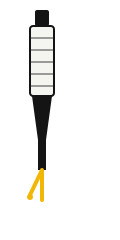 Illustration for editorial purposes
Opens live listings in a new tab.
OEM Part Number: confirm via engine code — aftermarket NGK 95929 / Bosch 0 241 145 525
| Petrol engines in this generation | 1.0 TSI 116 hp, 1.2 TSI 110 hp, 1.4 TSI 150 hp, 1.5 TSI 150 hp, 1.8 TSI 180 hp |
|---|---|
| Spark plugs (aftermarket) | NGK 95929 (iridium, 0.8 mm gap, M12x1.25, 16 mm hex); NGK 94224 (iridium, 0.8 mm gap, M12x1.25); NGK 97861 (platinum, 0.8 mm gap, M12x1.25); NGK 97124 and 93231 (platinum, M12x1.25); NGK 94833 (platinum, M14x1.25); Bosch 0 241 145 525 (0.75 mm gap, M12x1.25); Bosch 0 241 245 673 (0.7 mm gap, M14x1.25); Beru Z534, Z365 and Z507 (iridium with platinum, 0.8 mm gap, M12x1.25) |
| Genuine (OE) numbers quoted | Kamoka 7090007 quoted against OE 06K 905 601 B |
| Fitment notes | Brisk 2162 states a 100,000 km interval; no Denso, no copper. |
A Genuinely Reliable Way to Diagnose a Misfire Before Replacing Anything — Volkswagen Touran Spark Plugs
If you're chasing a misfire (fault codes P0300 for random/multiple cylinders, or P0301-P0304 for a specific cylinder), a genuinely reliable diagnostic technique before replacing anything: swap the ignition coil from the misfiring cylinder with one from a healthy cylinder, then check whether the misfire code follows the coil to its new position. If it does, the coil is confirmed faulty. If the misfire stays with the original cylinder, try the same test with the spark plug — swapping it to rule that out too. Only once both are ruled out should you look further afield, at carbon buildup on the intake valves (a well-known characteristic of direct-injection TSI engines, since fuel injected straight into the cylinder doesn't wash over and clean the valves the way port injection does) or a failing fuel injector.
It's worth knowing ignition coils on TSI engines don't have a fixed scheduled replacement interval the way plugs do, but many owners choose to replace them at the same time as the spark plugs (commonly every 40,000-60,000 miles) as cheap insurance, since a failed coil while driving can trigger an unexpected loss of power. If one coil has failed, replacing all of them together is generally the sensible approach rather than waiting for each to fail in turn.
Volkswagen Touran Spark Plugs: A Cheap Part That Causes Expensive-Feeling Problems
On the Volkswagen Touran, symptoms of worn spark plugs are subtle by nature — a touch rougher at idle, a little less responsive off the line — and easy to attribute to almost any other engine gremlin. Because the part itself is so cheap, it's routinely overlooked well past when it should've been changed.
Volkswagen Touran Spark Plugs: Watch: Replacing It
Generic 1.5 TSI, no Touran Mk2 plug video found (Touran results were glow plugs).

Volkswagen Touran Spark Plugs: What They Do
How well the Volkswagen Touran's engine runs, how efficiently it burns fuel, and how smooth it feels are all tied to spark plug condition, since these ignite the compressed fuel-air mixture in each cylinder. That's a petrol-engine job specifically — diesels ignite fuel through compression and have no spark plugs at all.
Volkswagen Touran Spark Plugs: Generations & Spark Plug Count
| Diesel variants | Not applicable — diesel engines use compression ignition and have no spark plugs at all |
|---|---|
| Petrol variants (all trims) | 4 spark plugs — one per cylinder |
Opens live listings in a new tab.
Volkswagen Touran Spark Plugs: Warning Signs, DIY Difficulty & Aftermarket Advice
These are the same regardless of make or model — see our full Spark Plugs Guide for symptoms of worn plugs, why matching your exact plug specification matters, and trusted brands to buy from.
More Volkswagen Spark Plugs
The same part, covered across other Volkswagen models.