
Volkswagen Up! Radiator: Specs, Fitment & Common Faults
If your Up! has a TSI turbo engine, VW has legally admitted to using "inferior thermoplastic materials" in the water pump housing — a real class-action settlement covers this.
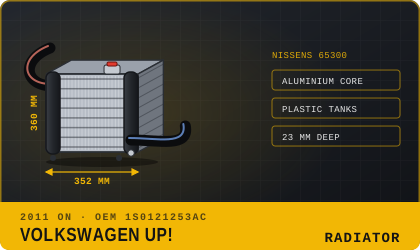 Illustration for editorial purposes
Opens live listings in a new tab.
OEM Part Number: 1S0121253AC
As quoted in catalogue listings, confirm via VIN. Aftermarket units: Nissens 65300 / Valeo 701128
| Radiators (aftermarket) | Nissens 65300 (352 x 360 x 23 mm, aluminium core with plastic tanks, fits 1.0 60 PS CHYA/DAFA and, with its Mii and Citigo sisters, the 1.0 75 PS CHYB and 1.0 EcoFuel CPGA); Nissens 606239 (588 x 257 x 26 mm, aluminium core with plastic tanks, fits 1.0 TSI 90 CHZA/DKLC and 1.0 GTI 115 DKRA); Valeo 701128; Denso DRM32036; Mahle CR 831 000S; NRF 53102 and 53101; Van Wezel 58002325 and 58012725; Hella 8MK 366 301-701 |
|---|---|
| Core sizes & variants | The normally aspirated 1.0 MPI engines take the small 352 x 360 mm radiator, which is also used by the Seat Mii, Skoda Citigo and the electric e-Up/e-Citigo. The turbocharged 1.0 TSI and GTI take a much wider 588 x 257 mm radiator (OE 1S0121253AC) that is unique to the turbo cars. |
| Genuine (OE) numbers quoted | 1S0121253AC (TSI/GTI); MPI radiator OE number not quoted |
| Fitment notes | The MPI radiator comes with gaskets and seals and has 32 mm connections; the TSI/GTI unit has 32.5 mm connections. Check for the turbo before ordering, as the two are not interchangeable. |
Why the Up! smells of coolant: the TSI fault
If your car has a TSI turbo petrol engine (particularly the EA888 family used across much of VW's range from around 2015 onward), this is the single most important thing to know before anything else on this page. The water pump and thermostat are combined into one integrated plastic housing, and this plastic becomes brittle and develops hairline cracks after thousands of ordinary heat cycles — leading to a coolant leak that's often difficult to spot at first. This isn't a minor manufacturing quirk: VW has confirmed through legal documents that "inferior thermoplastic materials were used" in these water pump components, and the issue has been the subject of multiple class-action lawsuits.
Watch for a low coolant warning, a sweet smell in the engine bay (especially after motorway driving), or fault codes P00B7, P2681, P1889, or P0128 — any of these are worth investigating immediately rather than topping up and continuing, since this failure can escalate from a slow leak to sudden, severe overheating within minutes. If this does need replacing, the entire water pump and thermostat housing assembly must be replaced together — never just one part of it.
The heat exchanger at the front of the Up!
This isn't a part anyone gets excited about, but on the Volkswagen Up!, overlooked cooling problems are responsible for most serious engine failures that aren't simple wear-and-tear. Catching the early symptoms is about the cheapest insurance available against a major bill later.
Watch: replacing itGerman alternative FHoKBjoBPwA (2012 Up rusted radiator)

The job of the core
Keeping the Volkswagen Up!'s engine temperature within safe limits comes down to the radiator's job of transferring heat from the coolant into the surrounding air. Automatic-gearbox versions often build in a second circuit for transmission fluid cooling too, which is exactly why fitting the wrong part number can cause two problems, not one.
Opens live listings in a new tab.
These are the same regardless of make or model — see our full Radiator Guide for the three common failure modes, confirming fitment against your VIN, and OEM vs aftermarket guidance.
The same part on other modelsThe same part, covered across other Volkswagen models.