
Audi Q3 Timing Belt: Intervals, Fitment & Warning Signs
On the Q3, the hydraulic timing chain tensioner's check valves leak down oil pressure while parked, causing a well-known cold-start rattle.
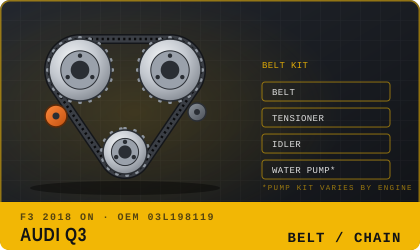 Illustration for editorial purposes
Opens live listings in a new tab.
OEM Part Number: 03L198119
| 8U (2011–2015), 2.0 TDI (EA189, CFFB / CLLB) | Genuine VW Group: 03L198119 family (03L198119F quoted). Aftermarket: ET Engineteam RM0023 / RM0023VR1 (with pump), Gates K015678XS, Contitech CT1228K1 |
|---|---|
| 8U (2015–2018), 2.0 TDI (EA288) | Genuine VW Group: 04L198119 family, confirm via VIN |
| 8U (2014–2018), 1.4 TFSI (EA211) | Genuine VW Group: 04E198119 family, confirm via VIN. Aftermarket: Contitech CT1167K1 |
| 8U, 2.0 TFSI (EA888) | Timing chain — no belt kit required |
| F3 (2018–present), 35 TFSI 1.5 (EA211 evo) | Genuine VW Group: 04E198119 family (belt 04E109119), confirm via VIN. Aftermarket: INA 530 0711 10, Contitech CT1167K7, Gates K055680XS |
| F3 (2018–present), 35 TDI 2.0 (EA288 evo) | Genuine VW Group: 05L198119A (confirm via VIN). Aftermarket: INA 530 0650 10 — note this is a different kit from the A3 8Y's INA 530 0835 30 |
| F3, 40 / 45 TFSI and RS Q3 (EA888 / 2.5 TFSI) | Timing chain — no belt kit required |
How a missed interval turns into a bigger bill on the Q3
Skipping this one on the Audi Q3 carries more downside risk than almost any other maintenance item on the car. On engines where it fails, the damage typically spreads well beyond the part itself, which is exactly why the replacement schedule matters more here than almost anywhere else.
On the Audi Q3, precise synchronisation between the camshafts and crankshaft is what the timing belt or chain provides, making sure valves open and close at exactly the right point relative to piston position. Many engines use what's called an "interference" design, where a belt failure lets pistons and valves collide, causing serious internal damage.
Engines and generations of the Q3 compared
| 8U (2011–2018), 2.0 TFSI petrol | Timing chain — see confirmation above |
|---|---|
| 8U, 1.4 TFSI & 2.0 TDI diesel | Timing belt — differs from the 2.0 TFSI, confirm your exact engine |
| F3 (2018–present), 1.5 TSI & 2.0 TDI | Timing belt — follows the Golf/Octavia MQB pattern |
| F3, 2.0 TSI incl. RS Q3 | Timing chain — larger EA888 unit |
Opens live listings in a new tab.
Why the Q3 can rattle for a second or two at start-up
If you're hearing a brief rattle on cold start-up, this is useful to know on the EA888 2.0 TFSI engine: the hydraulic timing chain tensioner relies on oil pressure to keep the chain properly taut, and internal check valves gradually leak this pressure down while the car sits parked, causing a characteristic one-to-three second rattle when the engine is first started. It's worth using your phone to record the rattle the next time it happens, since this kind of brief, intermittent noise can be difficult to reproduce on demand for a mechanic.
Audi's own internal guidance has reportedly instructed dealers not to replace chains or tensioners under warranty for this kind of rattle unless the noise is constant, rather than just present briefly on cold start — worth being aware of this specific threshold if you're pursuing a warranty repair.
Watch: Replacing ItThis covers the belt-driven 2.0 TDI diesel. Chain-driven petrol engines don't need this procedure — check which your car has above.
Warning signs, DIY difficulty and aftermarket adviceThese are the same regardless of make or model — see our full Timing Belt Guide for symptoms to watch for, confirming fitment against your VIN, and which aftermarket brands are worth trusting.
The same part on other modelsThe same part, covered across other Audi models.