
Dacia Jogger Spark Plugs: Intervals, Fitment & Warning Signs
On the Jogger, a genuine fitment trap: NGK replacement coils are rated 14V versus the original 12V units.
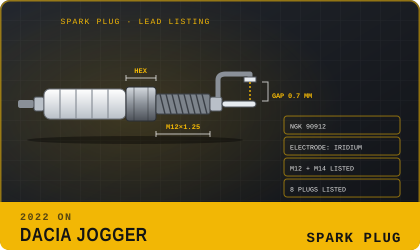 Illustration for editorial purposes
Opens live listings in a new tab.
OEM Part Number: confirm via engine code
Aftermarket plugs: NGK 90912 / Bosch 0 242 129 529
| Petrol engines in this generation | See the fitment notes |
|---|---|
| Spark plugs (aftermarket) | NGK 90912 (iridium, gap 0.7 mm, M12x1.25, 14 mm); NGK 90391 (iridium, 4.7 ohm, gap 0.7 mm, 14 mm); NGK 1496 (LPG Laser Line, M14x1.25, 16 mm, 60,000 km); Bosch 0 242 129 529 (gap 1.1 mm, 14 mm, 23 Nm); Bosch 0 241 140 537 (gap 0.7 mm, 23 Nm); Bosch 0 242 135 585 (gap 0.65 mm); Champion OE269 (iridium, gap 0.7 mm, 20-25 Nm); Champion OE261 (iridium, gap 0.7 mm) |
| Genuine (OE) numbers quoted | Renault 224019960R, 224019185R, 224019133R, 224015145R; Kamoka 7100016 = 22 40 191 33R |
| Fitment notes | Standard plugs are the M12x1.25, 14 mm iridium family with gap about 0.7 mm; the NGK 1496 is the separate 16 mm LPG plug with a 60,000 km interval, and Brisk 1989 lists 100,000 km. |
The Jogger shares its CMF-B platform and TCe engine with the Dacia Sandero and Renault Clio, so it's worth checking parts listings under those car names too — genuine components are frequently cross-listed. Plug specification differs between the TCe petrol engines and the larger 1.6-litre engine used in Hybrid versions.
A coil fitment catch on the Jogger
If you're replacing ignition coils and considering NGK as an alternative to the original fitment, one case found NGK replacement coils specified as 14V, while the original factory-fitted Hitachi units were rated at 12V — a genuine voltage mismatch that may explain compatibility issues some owners have experienced when mixing brands.
Bear in mind that why 3-cylinder engines often have a shorter plug replacement interval than you might expect on a low-mileage car: with fewer cylinders sharing the workload, each spark plug fires more frequently per crankshaft revolution, accelerating wear even at modest annual mileage.
A small part behind big symptoms
On the Dacia Jogger, symptoms of worn spark plugs are subtle by nature — a touch rougher at idle, a little less responsive off the line — and easy to attribute to almost any other engine gremlin. Because the part itself is so cheap, it's routinely overlooked well past when it should've been changed.
No Jogger video; Sandero 1.0 three-cylinder shares the platform and engine family
Why plug gap and heat range matter
How well the Dacia Jogger's engine runs, how efficiently it burns fuel, and how smooth it feels are all tied to spark plug condition, since these ignite the compressed fuel-air mixture in each cylinder. That's a petrol-engine job — diesels ignite fuel through compression and have no spark plugs at all.
Generations, Engines and Plug Count| Diesel variants (dCi) | Not applicable — diesel engines use compression ignition and have no spark plugs at all |
|---|---|
| 0.9/1.0 TCe/SCe (standard petrol trims) | only 3 spark plugs — this small turbocharged engine (co-developed with Nissan) is shared across Renault, Dacia and even some Smart models, not a four-cylinder |
| 1.3 TCe (higher trims, RS Line and similar) | 4 spark plugs — this larger engine (co-developed with Mercedes-Benz) is a completely different unit from the smaller 3-cylinder TCe, despite both sharing the "TCe" badge; confirm your exact engine before ordering |
Opens live listings in a new tab.
These are the same regardless of make or model — see our full Spark Plugs Guide for symptoms of worn plugs, why matching your exact plug specification matters, and trusted brands to buy from.
The same part on other modelsThe same part, covered across other Dacia models.