
Fiat 500 (Petrol) Brake Discs: Specs, Fitment & Wear Symptoms
On the classic petrol 500, the real root cause is often the reaction frame corroding, not the disc itself, capable of seizing and bending pads.
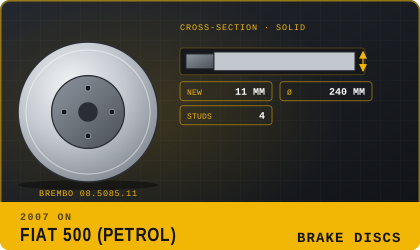 Illustration for editorial purposes
Opens live listings in a new tab.
OEM Part Number: confirm via VIN
Aftermarket front discs: Brembo 08.5085.11 / Bosch 0 986 479 B43
| Front brake discs (aftermarket) | Brembo 08.5085.11 (240 x 11 mm, solid, 4 holes, coated, Prime line); Brembo 08.5086.11 (257 x 12 mm, solid, 4 holes, coated); Brembo 09.9772.11 (312 x 25 mm, vented, 5 holes, coated, high-carbon, Abarth); Bosch 0 986 479 B43 (257.2 x 22 mm, vented, 4 holes, coated, ECE-R90); Bosch 0 986 478 343 (257.5 x 12 mm, solid, 4 holes, oiled); ATE 24.0111-0119.1 (241 x 11 mm, solid, 4 holes, coated); ATE 24.0112-0127.1 (257.5 x 12 mm, solid, 4 holes, coated); ATE 24.0122-0197.1 (257.5 x 22 mm, vented, 4 holes, coated) |
|---|---|
| Disc sizes & variants | Four front sizes are listed. The 240 x 11 mm solid disc is fitted to the base 1.2 petrol; the 257 x 12 mm solid disc to the 0.9 TwinAir and some 1.3 Multijet cars; the 257 x 22 mm vented disc to the higher-output 0.9 TwinAir 105, 1.4 16v and later 1.3 Multijet cars; and the 312 x 25 mm vented five-hole disc to the Abarth. A 284 x 22 mm vented disc (Ridex 82B0216) is also listed for the 1.4 Abarth-derived fitment. |
| Genuine (OE) numbers quoted | None quoted in catalogue listings — order genuine discs against your VIN |
| Fitment notes | Minimum thickness is 9.2 mm for the 240 mm solid disc, 10.2 mm for the 257 mm solid disc, 20.2 mm for the 257 mm vented disc and 22 mm for the 312 mm Abarth disc. Solid and vented 257 mm discs share the same diameter and stud pattern, so check which type the car has before ordering. |
What causes repeat brake corrosion on Fiat's 500 (Petrol)
If you're facing recurring corrosion-related brake problems, an explanation from an experienced owner traces the actual root cause to the reaction frame — the metal bracket the pads slide within, distinct from the disc or pad — being made from a grade of cast iron with low corrosion resistance. In the worst documented cases, pads can seize solid within the frame, with hydraulic pressure then physically bending the pad.
Also, brake disc corrosion is generally worse on cars that sit unused for extended periods, since regular driving naturally polishes surface corrosion away.
Watch: replacing them500 (2007-) front pads and discs
What carries the braking load at each wheel of the 500 (Petrol)
On the Fiat 500 (Petrol), wear on one of this pair accelerates wear on the other, so a pad change booked as routine maintenance often turns up discs that have quietly deteriorated alongside them.
How the rotors stop the 500 (Petrol)
Brake discs provide the surface the brake pads clamp against to slow the car, converting momentum into heat through friction. Larger, sportier trims of the 500 (Petrol) typically use bigger discs than standard versions to handle the additional heat generated by more aggressive braking.
Opens live listings in a new tab.
These are the same regardless of make or model — see our full Brake Discs Guide for warning signs to watch for, confirming fitment against your VIN, and choosing a reliable aftermarket disc.
The same part on other modelsThe same part, covered across other Fiat models.