
Fiat Panda Timing Belt: Intervals, Fitment & Warning Signs
The TwinAir uses a timing chain designed to last the car's life, while the conventional 1.2 Fire uses a belt needing replacement every 4-6 years — plus an honest root cause for diesel chain failures.
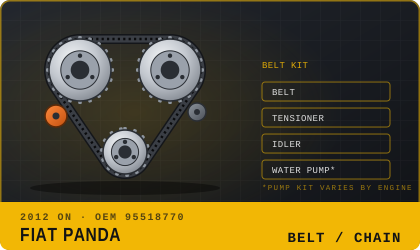 Illustration for editorial purposes
Opens live listings in a new tab.
OEM Part Number: 95518770
| 1.3 Multijet diesel, timing CHAIN kit (not belt) | Genuine reference: 95518770 — shared with Vauxhall Corsa/Astra/Meriva, Ford Ka, Suzuki Ignis, Alfa Romeo Mito |
|---|
A fixed change interval only applies to one Panda engine
Before assuming a fixed replacement interval applies to your Panda, the TwinAir engine uses a timing chain, designed to last the life of the car rather than needing scheduled replacement, whereas the conventional 1.2-litre Fire petrol engine uses a timing belt requiring replacement roughly every four to six years. Given how similarly these two engines are marketed and how easy it is to assume they share the same maintenance schedule, it's worth confirming which specific engine your car has rather than guessing based on the model name alone.
Also, an honest DIY difficulty warning if you're facing a timing chain cover oil leak on the TwinAir specifically: reaching the cover requires removing the cam cover, engine mount, water pump, belt, tensioner, and idler pulley, and accessing certain bolts requires also removing the alternator and air conditioning pump — a major undertaking rather than a quick weekend job, worth budgeting proper time and expecting a correspondingly higher labour cost if having this done professionally.
When the Panda is due for the job, and what leaving it costs
Few maintenance items on the Fiat Panda carry as much downside risk for skipping them. On the engines where this component fails, the consequences typically extend well beyond the part itself, which is exactly why sticking to the schedule matters more here than almost anywhere else on the car.
The Fiat Panda's timing belt or chain keeps the engine's camshafts and crankshaft rotating in precise synchronisation, ensuring valves open and close at exactly the right moment relative to piston position. On many engines, this is what's known as an "interference" design — if the belt fails, the pistons and valves can collide, causing serious internal engine damage.
Engines in the Panda range, split by cam drive
| 169 (2003–2012), 1.1/1.2/1.4 petrol | Timing belt — conventional dry belt |
|---|---|
| 312 (2012–present), 0.9 TwinAir & 1.2 petrol | Timing chain — no scheduled replacement interval |
| 312, 1.3 Multijet diesel | Timing chain — see confirmation above |
Opens live listings in a new tab.
This covers the belt-driven engine. Chain-driven variants don't need this procedure — check which your car has above.
Generations and Engines: Belt or Chain| 312 (2012–present), 0.9 TwinAir & 1.2 petrol | Timing belt — conventional dry belt |
|---|---|
| 312, 1.3 Multijet diesel | Timing chain — see confirmation above |
This covers the belt-driven petrol MultiAir range. The 1.3 Multijet diesel is chain-driven and doesn't need this procedure — see confirmation above.
Warning signs, DIY difficulty and aftermarket adviceThese are the same regardless of make or model — see our full Timing Belt Guide for symptoms to watch for, confirming fitment against your VIN, and which aftermarket brands are worth trusting.
The same part on other modelsThe same part, covered across other Fiat models.