
Honda Civic Radiator: Specs, Fitment & Common Faults
Using the wrong coolant type can cause real corrosion — plus a tricky DIY trap where the heater pipe can feel seated in the thermostat housing when it isn't.
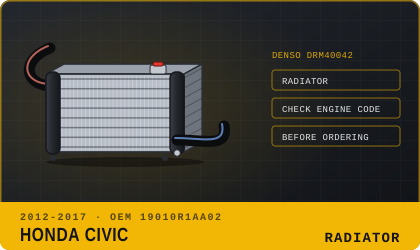 Illustration for editorial purposes
Opens live listings in a new tab.
OEM Part Number: 19010R1AA02
As quoted in catalogue listings, confirm via VIN. Aftermarket units: Denso DRM40042 / NRF 58537
| Radiators (aftermarket) | Denso DRM40042; NRF 58537; Ava HD2296; Van Wezel 25002701; AKS Dasis 100081N; Kale 347550. Denso DRM40043; NRF 59240; AKS Dasis 100083N. Denso DRM40041 |
|---|---|
| Core sizes & variants | Three distinct cores: the 1.4 petrol takes the smallest 325 x 656 mm radiator, the 1.8 petrol a 375 x 678 mm core and the 2.2 diesel a thicker 375 x 733 x 28 mm core. The 1.8 part is listed for manual gearboxes, so automatic cars should be checked against the VIN. |
| Genuine (OE) numbers quoted | 1.8: 19010R1AA02; 19010R1AA52. 1.4: 19010R3RE01. |
| Fitment notes | The 1.8 radiator is supplied with seals but without the expansion tank |
Why the wrong coolant harms the Civic
If you're topping up or refilling the cooling system, this is worth taking seriously: using the wrong type of coolant — not just mixing different brands, but the wrong chemical formulation for your specific engine — has been documented as a direct cause of internal corrosion. One case saw an OAT-type coolant used on an engine that expected a different formulation, causing corrosion that led to a persistent leak even after related components were replaced. Always confirm the correct coolant specification for your specific engine before topping up, rather than assuming any coolant labelled for the right colour or general purpose is compatible.
Also, a combination of elevated idle speed and rapid overheating shortly after thermostat or housing work often points toward trapped air in the cooling system rather than a genuine new leak — thoroughly bleeding the system after any work in this area is worth doing carefully, since an air pocket can mimic several other more serious symptoms.
Why the Civic depends on a healthy cooling pack
This isn't a part anyone gets excited about, but on the Honda Civic, overlooked cooling problems are responsible for most serious engine failures that aren't simple wear-and-tear. Catching the early symptoms is about the cheapest insurance available against a major bill later.
Watch: replacing itUS 9th-gen sedan; UK FK2 hatch front end differs slightly
How the Civic's fan and core work together
Keeping the Honda Civic's engine temperature within safe limits comes down to the radiator's job of transferring heat from the coolant into the surrounding air. Automatic-gearbox versions often build in a second circuit for transmission fluid cooling too, which is exactly why fitting the wrong part number can cause two problems, not one.
Opens live listings in a new tab.
These are the same regardless of make or model — see our full Radiator Guide for the three common failure modes, confirming fitment against your VIN, and OEM vs aftermarket guidance.
The same part on other modelsThe same part, covered across other Honda models.