
Hyundai i10 Battery: Specs, Fitment & Common Faults
On the i10, a case traced an intermittent drain spike to the "memory fuse" — pulling it reduced the drain to zero.
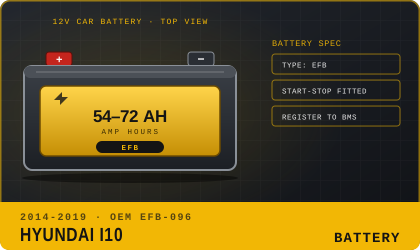 Illustration for editorial purposes
Opens live listings in a new tab.
OEM Part Number: EFB-096
| Non-Start/Stop models (standard wet-acid) | Type 063 (207 x 175 x 175mm) or 012 (207 x 175 x 190mm), 52-54Ah — measure your existing battery to confirm which case height fits |
|---|---|
| Mk3 i10 with Start/Stop (ISG) | Type EFB-096, EFB technology, 72Ah, 660 CCA — EFB is a genuine minimum requirement for this system |
| Important | Start/Stop-equipped models may have a sensor on the negative terminal monitoring charge state, and the battery management system may need resetting with a diagnostic tool after fitting. |
What stopped repeated flat starts on the i10
If your battery keeps going flat within just a few days despite testing as healthy, one case on a related Hyundai model found the background drain spiking briefly every few seconds, tracked down to a component sometimes referred to as the "memory fuse" — pulling this specific fuse reduced the drain to zero completely. If you're chasing a similar intermittent spike pattern rather than a constant drain, it's worth testing this fuse.
Connecting the jump leads plus-to-plus and minus-to-minus directly between batteries, rather than the more commonly recommended minus-to-engine-block method, has resolved cases where a standard jump start attempt failed despite the dashboard and accessories powering up correctly.
Watch: replacing itFilmed on an i10.
Before you buy a replacement
On the Hyundai i10, more non-starts get pinned on the battery than on any other single component, and that assumption is correct often enough to justify checking it first. It's not always the real cause, though, so it's worth confirming before spending money on a replacement that doesn't fix the problem.
Stop-start, electronics and cranking: the load
On the Hyundai i10, every engine start and every moment the electrical systems run without the engine turning draws on the 12V battery. Stop-start puts far more demand on that battery than older designs, given how often the engine cycles off and on — hence the need for an AGM or EFB battery instead of a standard type.
Opens live listings in a new tab.
These are the same regardless of make or model — see our full Battery Guide for warning signs to watch for, confirming fitment against your VIN, and matching the right technology (standard, EFB, AGM) when buying aftermarket.
The same part on other modelsThe same part, covered across other Hyundai models.