
Hyundai i20 Battery: Specs, Fitment & Common Faults
On the i20, a case traced an intermittent drain spike to the "memory fuse" — pulling it reduced the drain to zero.
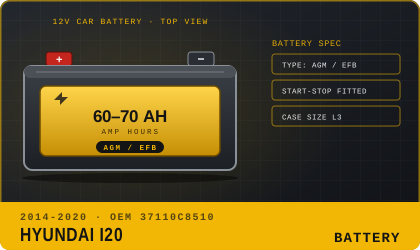 Illustration for editorial purposes
Opens live listings in a new tab.
OEM Part Number: 37110C8510
| 1.0 TGDi, genuine reference (AGM) | Hyundai OEM: 37110C8510 — CMF45L type, AGM technology |
|---|---|
| Standard petrol variants, Start/Stop | Type 027, EFB, 60Ah, 640A (EN) |
| Higher-demand variants | Type L3 (096), AGM, 70Ah, 760A (EN) |
The cure one owner found for a draining i20
If your battery keeps going flat within just a few days despite testing as healthy, one case on a related Hyundai model found the background drain spiking briefly every few seconds, tracked down to a component sometimes referred to as the "memory fuse" — pulling this specific fuse reduced the drain to zero completely. If you're chasing a similar intermittent spike pattern rather than a constant drain, it's worth testing this fuse.
Connecting the jump leads plus-to-plus and minus-to-minus directly between batteries, rather than the more commonly recommended minus-to-engine-block method, has resolved cases where a standard jump start attempt failed despite the dashboard and accessories powering up correctly.
Flat in the morning: what to check on the i20
Ask anyone why their Hyundai i20 won't start and "the battery" is usually the first guess, and it's frequently correct, which makes it a reasonable starting point. It's not always right, though, so it's worth ruling out other causes before spending on a replacement that changes nothing.
Watch: replacing itFilmed on a first-generation i20.

The job of the 12V unit under the bonnet
On the Hyundai i20, powering the engine start and running electrics while the engine's stopped both fall to the 12V battery. Stop-start technology puts significantly more strain on it than older designs, thanks to how frequently the engine cycles — explaining why a specific AGM or EFB battery is needed rather than a standard unit.
Opens live listings in a new tab.
These are the same regardless of make or model — see our full Battery Guide for warning signs to watch for, confirming fitment against your VIN, and matching the right technology (standard, EFB, AGM) when buying aftermarket.
The same part on other modelsThe same part, covered across other Hyundai models.