
Hyundai i30 Timing Belt: Intervals, Fitment & Warning Signs
On the i30, worth knowing as context: a real US recall covers a serious bearing failure on the Theta engine family used in larger Hyundai models.
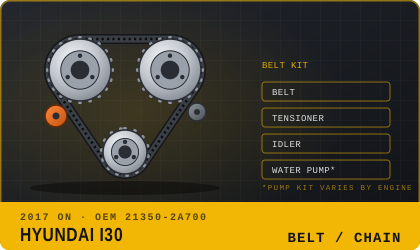 Illustration for editorial purposes
Opens live listings in a new tab.
OEM Part Number: 21350-2A700 (U-series chain kit reference)
| GD (2012–2017), 1.4 / 1.6 Gamma petrol | Timing chain. Aftermarket: ET Engineteam RS0058 (formerly RS0035, OE 24321-2B000) for the MPi; GDi: confirm via VIN |
|---|---|
| GD (2012–2017), 1.4 / 1.6 CRDi (U-series D4FB / D4FC) | Timing chain. Aftermarket: ET Engineteam RS0020VR1–3 chain kit (OE 21350-2A700 / 24351-2A000) |
| 1.0 T-GDi (Kappa G3LC / G3LE) | Timing chain — pre-2020 engines have a documented tensioner / cold-start rattle issue worth inspecting |
| 1.6 CRDi 115 / 136 (U3 D4FE, 2017 on) | Timing BELT — the newer U3 diesel switched from chain to a long-life belt. Genuine Hyundai/Kia and aftermarket kit: confirm via VIN |
| PD (2017 on), 1.4 T-GDi / 1.5 T-GDi Smartstream | Timing chain — confirm via VIN |
The i30's engine line-up and how each one is driven
| FD (2007–2012), all petrol (G4FA/G4FC) | Timing chain — no scheduled replacement interval |
|---|---|
| GD (2011–2017), all petrol | Timing chain — no scheduled replacement interval |
| PD (2016–present), all petrol & diesel, incl. N/N Line | Timing chain — confirmed directly by Hyundai N owner community |
Engine history for i30 buyers cross-shopping a Theta model
If you're cross-shopping against a larger Hyundai with a Theta engine, or simply want context on the brand's reliability history, Hyundai issued a genuine US safety recall covering models with the 2.0 and 2.4-litre Theta engine family, addressing a defect where connecting rod bearings could wear prematurely and, in the worst case, cause the engine to stall or seize while driving. This doesn't directly affect the smaller engines used in this specific model, but is useful to know as general context on a documented reliability issue within Hyundai's wider range.
A real technical service bulletin culture exists across Hyundai's range for various issues — worth asking a dealer directly whether any relevant bulletins apply to your specific car and engine if you're experiencing an unusual or persistent fault.
The cost of leaving the i30 too late
Skipping this one on the Hyundai i30 carries more downside risk than almost any other maintenance item on the car. On engines where it fails, the damage typically spreads well beyond the part itself, which is exactly why the replacement schedule matters more here than almost anywhere else.
On the Hyundai i30, precise synchronisation between the camshafts and crankshaft is what the timing belt or chain provides, making sure valves open and close at exactly the right point relative to piston position. Many engines use what's called an "interference" design, where a belt failure lets pistons and valves collide, causing serious internal damage.
Opens live listings in a new tab.
Since this is a chain, not a scheduled belt job, this video is only relevant if you're diagnosing or responding to symptoms of tensioner wear — commonly reported from around 130,000km on these engines.
Warning signs, DIY difficulty and aftermarket adviceThese are the same regardless of make or model — see our full Timing Belt Guide for symptoms to watch for, confirming fitment against your VIN, and which aftermarket brands are worth trusting.
The same part on other modelsThe same part, covered across other Hyundai models.