
Jaguar XF Spark Plugs: Intervals, Fitment & Warning Signs
A genuinely specific, real finding: on the supercharged V8, the coil packs and plugs are buried well out of sight, requiring the coolant hoses removed first — plus an honest account of a coil pack being accidentally damaged during a routine plug replacement.
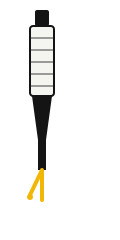 Illustration for editorial purposes
Opens live listings in a new tab.
Jaguar XF Spark Plugs: OEM Part Number
Jaguar XF Spark Plugs: A Cheap Part That Causes Expensive-Feeling Problems
On the Jaguar XF, there's rarely a clear signal when spark plugs wear out — just a rougher idle, marginally less pep off the line — vague enough to get pinned on other engine issues. Since the part costs so little, it's also one of the easiest things to keep putting off.
Jaguar XF Spark Plugs: What They Do
On the Jaguar XF, combustion efficiency, fuel economy and smooth running all trace back to spark plug condition, since these are what ignite the compressed fuel-air mixture in each cylinder. Petrol engines depend on them entirely — diesels skip spark plugs altogether, igniting fuel through compression instead.
Jaguar XF Spark Plugs: Generations, Engines & Spark Plug Count
| Diesel variants (all Ingenium diesel derivatives) | Not applicable — diesel engines use compression ignition and have no spark plugs at all |
|---|---|
| Petrol four-cylinder (25t, 20d Ingenium petrol variants, 2.0-litre) | 4 spark plugs — one per cylinder |
| Petrol six-cylinder, earlier examples (S, 35t V6 supercharged) | 6 spark plugs — a genuinely different engine family (Jaguar's supercharged V6), confirmed discontinued from the range in favour of four-cylinder and inline-six Ingenium units on later cars |
Opens live listings in a new tab.
A Genuinely Specific, Real Finding Worth Knowing About Access Difficulty — Jaguar XF Spark Plugs
On the supercharged V8 specifically, this is genuinely worth knowing before attempting this job yourself: the coil packs and spark plugs are buried well out of sight, requiring the four supercharger coolant hoses to be removed first, using a specific push-pull technique that takes some practice, followed by two rubber covers that are also difficult to remove and refit. The rear two coils in particular are notoriously awkward to access, typically needing either the factory special tool or an improvised equivalent, and the spark plugs themselves are harder still to remove, again requiring a special tool given how little room there is to work. It's genuinely worth budgeting significantly more time for this job than you might expect, or seeking a specialist familiar with this specific engine.
It's also genuinely worth knowing a useful, money-saving recommendation: checking for an oil leak from the valve cover gaskets before replacing any ignition coils is worthwhile, since leaking oil reaching the coils can damage even brand new replacements, leading to the same failure repeating shortly after the repair. It's also worth knowing that genuine, Jaguar-branded spark plugs have, in at least one documented case, turned out to simply be rebadged NGK plugs inside Jaguar's own packaging — worth knowing there may be no genuine difference beyond the box itself.
Jaguar XF Spark Plugs: Warning Signs, DIY Difficulty & Aftermarket Advice
These are the same regardless of make or model — see our full Spark Plugs Guide for symptoms of worn plugs, why matching your exact plug specification matters, and trusted brands to buy from.
More Jaguar Spark Plugs
The same part, covered across other Jaguar models.