
Land Rover Defender Radiator: Specs, Fitment & Common Faults
A genuinely useful piece of context worth knowing about cooling system faults: related models have had a confirmed recall for a water pump belt issue risking coolant leaking onto the hot turbocharger.
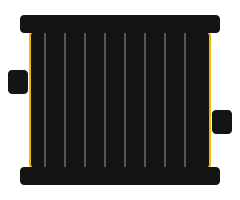 Illustration for editorial purposes
Opens live listings in a new tab.
Land Rover Defender Radiator: OEM Part Number
| Manual gearbox (older models, where fitted) | No dedicated transmission cooler required |
|---|---|
| Automatic (ZF), standard climate markets | A plate-type transmission fluid cooler is bolted to the left-hand end of the main radiator, using engine coolant to cool the transmission fluid — a genuinely distinct bolt-on unit rather than a tank built into the radiator itself; a documented failure sees the bonnet release cable rub against the cooler housing and wear a hole in it over time |
| Automatic, hot-climate markets | An additional auxiliary transmission fluid cooler is fitted alongside the standard plate cooler, genuinely providing extra capacity for higher ambient temperatures — not fitted on standard climate-market cars |
| MHEV (mild hybrid) variants | An additional auxiliary radiator/cooling circuit is fitted for the 48V mild hybrid components, on top of the standard engine and transmission cooling — confirm before ordering, since this isn't present on non-hybrid variants |
| Fitment note | If the plate cooler fails internally, coolant and transmission fluid can cross-contaminate into a pink, milkshake-like fluid — a serious failure requiring the cooler (and potentially the transmission) to be addressed urgently, not just a coolant top-up |
Land Rover Defender Radiator: The Part That Keeps Everything Else From Cooking
There's nothing exciting about this component, yet on the Land Rover Defender, most catastrophic engine failures that aren't simply down to wear trace back to a cooling problem someone ignored too long. Catching it early is cheap; catching it late usually isn't.
Land Rover Defender Radiator: What It Does
The Land Rover Defender radiator's core job is moving heat out of the engine coolant and into the passing air, holding engine temperature within safe limits. Automatic versions frequently add a second internal circuit for transmission fluid cooling, which is exactly why the correct part number carries extra weight on this component.

Opens live listings in a new tab.
A Genuinely Useful Piece of Context Worth Knowing About Cooling System Faults — Land Rover Defender Radiator
If you're facing a coolant leak or overheating concern, this is genuinely worth knowing: related Land Rover models have had a confirmed safety recall addressing a water pump drive belt issue that could rupture a plastic coolant elbow, risking coolant leaking onto a hot turbocharger, worth checking your VIN against the official recall register if you have a plug-in hybrid variant.
It's also genuinely worth knowing that the correct coolant type has varied by model year and VIN range over time, worth confirming exactly which type your car requires before topping up.
Land Rover Defender Radiator: Faults, DIY Difficulty & Aftermarket Advice
These are the same regardless of make or model — see our full Radiator Guide for the three common failure modes, confirming fitment against your VIN, and OEM vs aftermarket guidance.
More Land Rover Radiator
The same part, covered across other Land Rover models.