
Land Rover Discovery Sport Front Bumper: Fitment, Sensors & Common Damage
Listening for a clicking sound from each sensor individually helps isolate which specific one is faulty — plus an account that salt or sand grains stuck in a sensor almost always resolve after a proper wash.
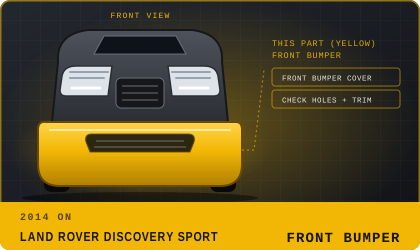 Illustration for editorial purposes
Opens live listings in a new tab.
OEM Part Number: confirm via VIN
No aftermarket cover listed for this generation
| Front bumper covers (aftermarket) | No complete aftermarket cover listed for this generation — order genuine against your VIN or use a used panel in your colour |
|---|---|
| Splitters, outer sections & trims | None listed separately |
| Genuine (OE) numbers quoted | None quoted in the catalogue listings — the genuine cover varies by body style, trim, parking sensors and fog lights, so order it against your VIN |
| Fitment notes | Match body style, trim, facelift date and the holes for parking sensors, fog lights and washer jets; covers come primed and need painting to your paint code before fitting. |
What a low-speed bump at the front can damage on the Discovery Sport
The Land Rover Discovery Sport's front bumper routinely integrates parking sensors, adaptive cruise control radar, and fog light housings, which means replacing it after even minor impact damage often involves more than a straightforward swap.
The front-end structure of the Discovery Sport, explained
Beyond absorbing minor impacts, the front bumper on higher trims of the Discovery Sport often houses parking sensors, the radar sensor used for adaptive cruise control, and fog lights. A bumper that looks compatible can still be missing the correct cutouts or mounting provisions for your specific trim's equipment.
Watch: replacing it
| L550 (2014–2019) | Fuji White, Santorini Black, Indus Silver, Namib Orange |
|---|---|
| L550 facelift (2019–present) | Fuji White, Santorini Black, Eiger Grey, Firenze Red, Varesine Blue, Hakuba Silver |
Opens live listings in a new tab.
Checking each sensor on the Discovery Sport with the ignition on
If parking sensors are giving inconsistent or missing warnings, with the ignition on and the car in reverse, listening closely to each individual sensor for a faint clicking sound is a useful way to confirm all of them are functioning, since every working sensor should click. This can help isolate exactly which specific sensor, among several, is silent and faulty, rather than needing to test them all at once.
A sensor physically pushed back into the bodywork by a minor knock, even with no other visible damage, can cause it to think something is very close by, sounding off constantly at low speeds — worth checking each sensor is sitting flush if you're getting persistent, seemingly false warnings.
Common damage, DIY difficulty and aftermarket adviceThese are the same regardless of make or model — see our full Front Bumper Guide for common damage types to check for, confirming fitment against your VIN, and the sensor-calibration risk with cheap aftermarket covers.
The same part on other modelsThe same part, covered across other Land Rover models.