
Land Rover Discovery Sport Spark Plugs: Intervals, Fitment & Warning Signs
On the Discovery Sport, related Land Rover engines genuinely use a wasted spark system, where each coil fires two specific cylinders together.
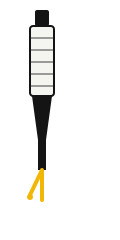 Illustration for editorial purposes
Opens live listings in a new tab.
OEM Part Number: confirm via engine code — aftermarket NGK 93710 / Bosch 0 242 140 566
| Petrol engines in this generation | 2.0 Si4 241 HP (4x4); diesel 2.0 D 150 HP also listed |
|---|---|
| Spark plugs (aftermarket) | NGK 93710 (iridium, 0.7 mm gap, M12x1.25, 14 mm hex, 28 mm reach); Bosch 0 242 140 566 (0.7 mm gap, M12x1.25, 14 mm hex, 26.5 mm reach); Champion OE277 (iridium, 0.7 mm gap, M12x1.25, 14 mm hex, 26.5 mm reach); Bosch 0 242 236 675 (0.7 mm gap, M14x1.25, 16 mm hex, 25 mm reach); Champion CCH9016 (iridium centre, 0.8 mm gap, M14x1.25, 16 mm hex, 25 mm reach); Denso IK20TT (iridium centre, platinum earth, M14x1.25, 19 mm reach); Beru UPT8 (0.9 mm gap, M14x1.25, 21 mm hex) |
| Genuine (OE) numbers quoted | None quoted in catalogue listings — order genuine plugs against your VIN / engine code |
| Fitment notes | Two plug families appear for this model: a long-reach M12x1.25 / 14 mm iridium plug (NGK 93710, Champion OE277, Bosch 0 242 140 566) and an M14x1.25 / 16 mm plug (Bosch 0 242 236 675, Champion CCH9016); the plugs are not matched to individual engine codes, so check the fit against the 2.0 Si4 before buying. NGK quotes 60,000 km for its LPG line only; no petrol change interval is given. |
Land Rover Discovery Sport Spark Plugs: A Cheap Part That Causes Expensive-Feeling Problems
A worn set of spark plugs in the Land Rover Discovery Sport doesn't make itself obvious: idle roughens slightly, acceleration loses a bit of urgency, and both symptoms are easy to blame on something else entirely. Given how inexpensive the part is, it often gets neglected for far longer than it should.
Land Rover Discovery Sport Spark Plugs: What They Do
Every combustion cycle in the Land Rover Discovery Sport's petrol engine starts with a spark plug igniting the compressed fuel-air mixture, and their condition shapes efficiency, economy and smoothness directly. Diesel versions don't need them at all, relying purely on compression to ignite fuel.
Land Rover Discovery Sport Spark Plugs: Generations, Engines & Spark Plug Count
| Diesel variants (eD4, SD4, D165, D180 and similar) | Not applicable — diesel engines use compression ignition and have no spark plugs at all |
|---|---|
| Petrol variants (all Si4 Ingenium derivatives) | 4 spark plugs — one per cylinder, as this model has been offered exclusively with four-cylinder petrol engines |
Land Rover Discovery Sport Spark Plugs: Watch: Replacing It
No Discovery Sport plug video found; Evoque shares the 2.0 Si4 petrol. Engine match inferred from model, not confirmed in video.
Opens live listings in a new tab.
A Genuinely Useful Piece of Context Worth Knowing About Misfires — Land Rover Discovery Sport Spark Plugs
If you're facing a misfire, this is genuinely worth knowing: related Land Rover engines have used a wasted spark ignition system, where each coil fires two specific cylinders together, meaning a genuine coil failure should typically produce a misfire matching a specific pair rather than a single, isolated cylinder.
It's also genuinely worth knowing that the official service interval for platinum spark plugs has been described by experienced mechanics as genuinely too long in practice on related models, with a widened gap at high mileage potentially burning out leads and coils.
Land Rover Discovery Sport Spark Plugs: Warning Signs, DIY Difficulty & Aftermarket Advice
These are the same regardless of make or model — see our full Spark Plugs Guide for symptoms of worn plugs, why matching your exact plug specification matters, and trusted brands to buy from.
More Land Rover Spark Plugs
The same part, covered across other Land Rover models.