
Mazda 6 Exhaust System: Specs, Fitment & Common Faults
On the Mazda 6, if diesel, two independent mechanics described diesel fuel contaminating the oil as a known manufacturing fault, with Mazda quoting £9,000 for a replacement engine.
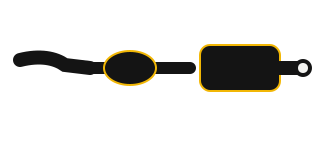 Illustration for editorial purposes
Opens live listings in a new tab.
OEM Part Number: confirm via VIN — Rear silencer (aftermarket) Bosal 171-019 / Walker 23079
| Rear silencer (back box) — aftermarket | Walker 23079 (700 mm, code 52); Walker 71393; Walker 21303; Bosal 171-019 / 171-055 / 171-635 / 171-045 (accessories needed); Ernst 670074; Vegaz MZS-178 (rear), MZS-189 (1200/700 mm), MZS-209 (0.75 m), MZS-220 (right), MZS-221 (left); MTS 01.69100 (960 mm), 01.92260 |
|---|---|
| Centre / intermediate silencer — aftermarket | Walker 23109; Bosal 171-377; Vegaz MZS-198, MZS-199, MZS-156 (manual), MZS-169, MZS-16; Hella 8LC 366 024-061 / -071; Izawit 17.079 |
| Front pipe / catalytic converter (DPF on diesels) — aftermarket | Oyodo 10N0217-OYO (OBD, Euro 5/6); BM Catalysts BM92384H (Euro 5, with FK92384); Quinton Hazell QCAT90454H; NAP CAK10405 (ZL05/ZL06, Euro 3); NAP CAK10261 (Euro 4); Walker 28532 / 28109; JMJ 1091529 |
| Genuine (OE) numbers quoted | None quoted in catalogue listings — order genuine parts against your VIN |
| Fitment notes | engines petrol 2.0/2.5, diesel 2.2D; mixed-in older-engine NAP cats (Euro 2) clearly not GJ. |
A Genuinely Severe, Real Issue Worth Understanding on Diesel Models — Mazda 6 Exhaust System
This is genuinely important to understand on the 2.2 diesel engine specifically: unburnt diesel fuel injected during a DPF regeneration cycle can, in some documented cases, work its way past the piston rings and into the engine oil, progressively diluting and contaminating it. One documented case saw two independent mechanics both describe this as a known manufacturing fault, with the contaminated oil eventually causing the engine to knock and fail entirely — Mazda themselves quoted around £9,000 for a full replacement engine in this case.
It's also worth knowing about a genuinely specific symptom combination: a warning specifically referencing "SCBS forward malfunction" during deceleration or engine braking, alongside a general engine warning light, has been documented as pointing toward significant carbon buildup in the intake manifold requiring a full decoke.
Mazda 6 Exhaust System: The Part That Announces Its Own Problems
On the Mazda 6, this is one of the few parts where your ears will catch a problem before your eyes do — a new rattle, a drone, noise that simply wasn't there a week ago. That's a genuine advantage, since it gives you an early warning most other faults don't offer.
Mazda 6 Exhaust System: Watch: Replacing It
Aftermarket system fitting on 2014+ Mazda 6 (GJ/GL)
Mazda 6 Exhaust System: What It Does
On the Mazda 6, burnt gases leave the engine through the exhaust system, which quiets them via the silencer and treats emissions through a catalytic converter and particulate filter before anything exits the tailpipe. Petrol and diesel versions frequently use entirely different systems, since their emissions treatment needs aren't the same.
Opens live listings in a new tab.
Mazda 6 Exhaust System: Warning Signs, DIY Difficulty & Aftermarket Advice
These are the same regardless of make or model — see our full Exhaust System Guide for warning signs and fault codes to watch for, confirming fitment against your VIN, and which aftermarket brands are worth trusting.
More Mazda Exhaust System
The same part, covered across other Mazda models.