
Mercedes-Benz A-Class Spark Plugs: Intervals, Fitment & Warning Signs
A genuinely alarming, honest account: a persistent misfire that survived replacing the coil pack, spark plugs, and injector was ultimately suspected to be a genuine cylinder head issue — a compression test is the recommended way to confirm this.
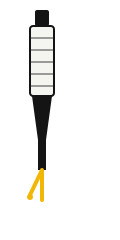 Illustration for editorial purposes
Opens live listings in a new tab.
OEM Part Number: confirm via engine code — aftermarket NGK 90654 / Bosch 0 241 140 537
| Petrol engines in this generation | A 160 (176.041) 102 HP and other 176-series petrol variants; diesel (CDI) variants also listed |
|---|---|
| Spark plugs (aftermarket) | NGK 90654 (iridium, M12x1.25, 14 mm hex); NGK 95875 (iridium, M12x1.25, 14 mm hex, 1 kOhm suppressor); Champion OE269 (iridium, 0.7 mm gap, M12x1.25, 14 mm hex); Bosch 0 241 140 537 (0.7 mm gap, M12x1.25, 14 mm hex); Beru Z502 (iridium centre, platinum earth, 0.7 mm gap, M12x1.25, 14 mm hex); Kamoka 7100064 (iridium, 14 mm hex); Ridex 686S0112 (0.7 mm gap, M12x1.25, 14 mm hex) |
| Genuine (OE) numbers quoted | Vemo V99-75-0083 = A 270 159 06 00; Renault 224019185R quoted as an OE part |
| Fitment notes | The M270 four-cylinder petrols take an M12x1.25 / 14 mm hex iridium plug with a 0.7 mm gap; the M14x1.25 / 16 mm plugs in the list (NGK 6418, Bosch 0 242 236 571) are for other applications, so match the engine before ordering. Brisk 1989 quotes a 100,000 km interval; NGK quotes 60,000 km for LPG only. |
Mercedes-Benz A-Class Spark Plugs: A Cheap Part That Causes Expensive-Feeling Problems
Worn spark plugs on the Mercedes-Benz A-Class rarely announce themselves clearly — a slightly rougher idle, a bit less punch off the line — symptoms easy to blame on almost anything else in the engine bay. The part itself costs very little, which makes it an easy one to overlook for far longer than it should be.
Mercedes-Benz A-Class Spark Plugs: What They Do
The Mercedes-Benz A-Class's spark plugs ignite the compressed fuel-air mixture inside each cylinder, and their condition directly affects combustion efficiency, fuel economy and smooth running. Petrol engines rely entirely on them; diesel engines don't use spark plugs at all, relying on compression instead.
Mercedes-Benz A-Class Spark Plugs: Generations & Spark Plug Count
| Diesel variants | Not applicable — diesel engines use compression ignition and have no spark plugs at all |
|---|---|
| Petrol variants (all standard trims) | 4 spark plugs — one per cylinder |
| AMG 35/45 performance trims, where fitted | Also 4 spark plugs — these use a more highly-tuned version of the same four-cylinder engine family rather than a different cylinder count |
Mercedes-Benz A-Class Spark Plugs: Watch: Replacing It
M270 engine used in W176; generation not confirmed from title. German alternative: BBrAg6w6dc0 (MB W176 A180 Zündkerzen wechseln).
Opens live listings in a new tab.
A Genuinely Alarming, Honest Real Account Worth Knowing — Mercedes-Benz A-Class Spark Plugs
If a persistent misfire has survived replacing the coil pack, spark plugs, and even a fuel injector, this is genuinely worth knowing: one documented case saw exactly this on this engine, with the misfire proving completely unresponsive to all three of these standard electrical fixes. This was ultimately suspected to point toward a genuine cylinder head issue, similar to a known problem documented on the performance variant of this platform, with a compression test recommended as the way to properly confirm this before spending further money on electrical components that won't resolve it. Worth requesting a compression test specifically if a misfire on a particular cylinder has already survived a coil, plug, and injector replacement without any improvement.
It's also genuinely worth knowing that some engines in this range have separate reported issues affecting cold starting and rough running that can present with similar symptoms to a genuine spark plug or coil fault, worth having a full diagnostic scan carried out rather than assuming ignition components are automatically the cause.
Mercedes-Benz A-Class Spark Plugs: Warning Signs, DIY Difficulty & Aftermarket Advice
These are the same regardless of make or model — see our full Spark Plugs Guide for symptoms of worn plugs, why matching your exact plug specification matters, and trusted brands to buy from.
More Mercedes-Benz Spark Plugs
The same part, covered across other Mercedes-Benz models.