
Mercedes-Benz C-Class Spark Plugs: Intervals, Fitment & Warning Signs
Swapping coil packs to isolate a misfire, a technique that works reliably on most cars, has confused even experienced mechanics here, since the fault code can stay locked to the original cylinder rather than following the coil.
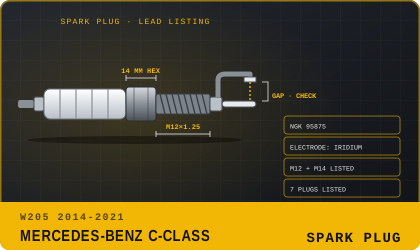 Illustration for editorial purposes
Opens live listings in a new tab.
OEM Part Number: confirm via engine code
Aftermarket plugs: NGK 95875 / Bosch 0 241 140 537
| Petrol engines in this generation | 205.064 and other 205-series petrol variants; diesel 205.001 also listed |
|---|---|
| Spark plugs (aftermarket) | NGK 95875 (iridium, M12x1.25, 14 mm hex); NGK 97566 (iridium, M12x1.25, 14 mm hex); NGK 90654 (iridium, M12x1.25, 14 mm hex); Champion OE269 (iridium, 0.7 mm gap, M12x1.25, 14 mm hex); Bosch 0 241 140 537 (0.7 mm gap, M12x1.25, 14 mm hex); Beru Z502 (iridium centre, platinum earth, 0.7 mm gap, M12x1.25, 14 mm hex); Denso IK20TT (iridium TT, M14x1.25, 19 mm reach) |
| Genuine (OE) numbers quoted | Vemo V99-75-0083 = A 270 159 06 00; Renault 224019185R quoted as an OE part |
| Fitment notes | The common petrol engines take an M12x1.25 / 14 mm hex iridium plug with a 0.7 mm gap (NGK 95875, 97566 and 90654 are the NGK options); M14x1.25 / 16 mm plugs such as Denso IK16TT and NGK 2477 apply to other engines, and the plugs are not tied to individual engine codes. Brisk 1989 quotes a 100,000 km interval. |
The low-cost service item that keeps the C-Class sharp
On the Mercedes-Benz C-Class, symptoms of worn spark plugs are subtle by nature — a touch rougher at idle, a little less responsive off the line — and easy to attribute to almost any other engine gremlin. Because the part itself is so cheap, it's routinely overlooked well past when it should've been changed.
What happens at the tip of each plug in the C-Class
How well the Mercedes-Benz C-Class's engine runs, how efficiently it burns fuel, and how smooth it feels are all tied to spark plug condition, since these ignite the compressed fuel-air mixture in each cylinder. That's a petrol-engine job — diesels ignite fuel through compression and have no spark plugs at all.
Generations, Engines and Plug Count| Diesel variants (C200d, C220d, C300d and similar) | Not applicable — diesel engines use compression ignition and have no spark plugs at all |
|---|---|
| Petrol four-cylinder (C180, C200, C300) | 4 spark plugs — one per cylinder |
| C63 AMG, older generations (W204/W205, pre-2023) | 8 spark plugs — these earlier C63 AMGs used a naturally aspirated or twin-turbo V8, a completely different engine family from the standard four-cylinder cars |
| C63 (current generation, 2023–present) | reverted to 4 spark plugs — the latest C63 uses a turbocharged 2.0-litre four-cylinder plug-in hybrid powertrain, producing more power than the previous V8 despite having half as many cylinders; a well-documented and controversial engineering shift, not a mistake or typo |
Alternative: E-vI46fd0dk (W205/S205 guide).
Opens live listings in a new tab.
A coil-swap test with a catch
If you're trying to isolate which cylinder is misfiring by swapping coil packs between cylinders, this standard diagnostic technique, which works reliably on most cars, has confused even experienced, time-served mechanics on this platform, since the fault code can sometimes stay locked to the original cylinder position rather than following the coil to its new location. Before assuming a swap test has definitively ruled out the coil as the cause, since the result may not behave the way you'd expect from experience with other vehicles.
Applying a small amount of dielectric grease between the top of the spark plug and the coil boot during any plug or coil replacement is a step worth taking, helping prevent future connection issues.
Warning signs, DIY difficulty and aftermarket adviceThese are the same regardless of make or model — see our full Spark Plugs Guide for symptoms of worn plugs, why matching your exact plug specification matters, and trusted brands to buy from.
The same part on other modelsThe same part, covered across other Mercedes-Benz models.