
Mercedes-Benz C-Class Rear Shock Absorber: Specs, Fitment & Common Faults
AIRMATIC air suspension extends to the rear axle too — and conversion kits exist precisely because it's a completely different technology from a standard shock.
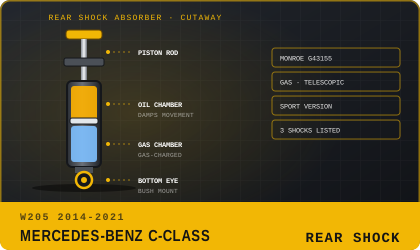 Illustration for editorial purposes
Opens live listings in a new tab.
OEM Part Number: confirm via VIN
Aftermarket rear dampers: Monroe G43155 / Febi Bilstein 1002615
| Rear shock absorbers (aftermarket) | Monroe G43155 (gas, telescopic); Febi Bilstein 1002615 (gas, telescopic); Febi Bilstein 1002856 (gas, telescopic, sport) |
|---|---|
| Genuine (OE) numbers quoted | None quoted in the catalogue listings — the genuine damper varies by engine, suspension type and body style, so order it against your VIN |
| Standard steel-spring shock, right | a different part number from the left-side shock, and from the AIRMATIC version below — confirm side and suspension type before ordering |
| Standard steel-spring shock, left | A different reference from the right-side shock above |
| AIRMATIC rear air shock (with or without 4MATIC) | a different suspension medium from the standard steel-spring shock — an air spring combined with the shock absorber in one assembly, not interchangeable with a conventional shock even at the same mounting points |
| AIRMATIC with ADS (Adaptive Damping System) | A further distinct variant again from base AIRMATIC — adds electronically controlled damping, and is a different part from non-ADS AIRMATIC shocks |
Arnott and other specialists suggest replacing AIRMATIC rear shocks in pairs, consistent with general shock absorber best practice.
Why the AIRMATIC C-Class needs a different technology
Important to establish before ordering: AIRMATIC-equipped cars use a rear air spring combined with the shock absorber, replacing the conventional steel coil spring entirely — not a stiffer version of a standard shock, but a different suspension medium. This is confirmed by the existence of genuine aftermarket conversion kits that replace AIRMATIC air struts with complete conventional strut-and-coil-spring assemblies, precisely because owners sometimes want to move away from the air system's cost and complexity. AIRMATIC with ADS (Adaptive Damping System) is a further distinct variant again, adding electronic damping control on top of the air spring.
Signs the C-Class back end has lost its control
The Mercedes-Benz C-Class's front end tends to dominate suspension conversations since it steers the car, but rear shock wear happens at a comparable rate — just with subtler warning signs that often get blamed on road noise until they're too obvious to ignore.
The job of each shock at the back of the C-Class
The rear shock absorber controls how quickly the rear suspension compresses and rebounds over bumps. On standard steel-spring cars it works independently of the coil spring; on AIRMATIC cars, the shock and air spring are combined into one assembly. A worn rear shock lets the back of the car bounce excessively after a bump instead of settling quickly.
Opens live listings in a new tab.
These are the same regardless of make or model — see our full Rear Shock Absorber Guide for symptoms of a worn shock, confirming fitment against your VIN, and OEM vs aftermarket guidance.
The same part on other modelsThe same part, covered across other Mercedes-Benz models.