
Mitsubishi L200 Tail Lights: Specs, Fitment & Common Faults
On the L200, tail light condensation should dissipate within about one hour of the lights being switched on, per official Mitsubishi campaigns on related models.
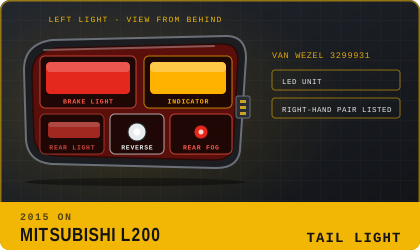 Illustration for editorial purposes
Opens live listings in a new tab.
OEM Part Number: confirm via VIN
Aftermarket rear lamps: Van Wezel 3299931 / TYC 11-15098-06-2
| Tail lights (aftermarket) | Van Wezel 3299931 (left, without bulb holder, right-hand pair 3299932); Van Wezel 3299925 (left, LED, with bulb holder, right-hand pair 3299926); TYC 11-15098-06-2 (left, LED, with bulb holder); Alkar 2207022 (left, LED, without bulb holder) |
|---|---|
| Genuine (OE) numbers quoted | None quoted in the catalogue listings — the genuine light varies by trim, bulb or LED type and facelift date, so order it against your VIN |
| Fitment notes | Left and right are separate parts; check LED or bulb type, whether the bulb holder is included, body style and facelift date before ordering. |
Why the L200's rear lamps are part of a wider circuit
The Mitsubishi L200's tail light unit typically bundles several functions into one housing — brake light, indicator, reversing light and rear fog light — which means a single electrical fault can affect more than one function at once, and a "faulty tail light" can mean several different things.
Signalling, braking and visibility on the L200
Beyond basic rear visibility, tail light units on the L200 typically integrate brake lights, indicators, reversing lights and rear fog lights into a single housing. Higher trims may use LED units with a distinct light signature, which are not interchangeable with standard halogen units even if the physical mounting looks similar.
Watch: replacing it
| Standard trims | Halogen bulb-based units as standard |
|---|---|
| Higher trims, later model years | LED tail lights become available further up the range, a different assembly and connector from the halogen units on lower trims |
Tail light design changed between generations of the L200, and facelifted versions within the same generation often use a revised light signature that isn't interchangeable with pre-facelift units. Always confirm the exact part for your specific model year before ordering. Whether you're sourcing a replacement tail lights for your Mitsubishi L200 from a dealer, specialist, or online marketplace, always check compatibility against your registration or VIN before buying, and confirm you're ordering the correct side — driver's side (RH in the UK) or passenger side (LH in the UK) — since these are not interchangeable.
Opens live listings in a new tab.
What Mitsubishi's campaign covered
If you're seeing condensation in a tail light, Mitsubishi has run official service campaigns on related models addressing this exact issue, with a clear, objective test worth using yourself first — moisture inside the light should dissipate within about one hour after the lights have been switched on. If it doesn't clear within roughly that timeframe, this points toward moisture having penetrated the assembly due to a crack or a manufacturing fault.
Documented cases describe moisture returning to a tail light even after a covered replacement, sometimes years later — worth knowing that even a covered replacement doesn't necessarily guarantee the issue won't recur.
Common faults, DIY difficulty and aftermarket adviceThese are the same regardless of make or model — see our full Tail Lights Guide for diagnosing which circuit has failed, how easy this job is to DIY, and aftermarket advice.
The same part on other modelsThe same part, covered across other Mitsubishi models.